

English translations of Heidegger's writings
Pictures of book covers link to the book at Amazon. Required verbiage: “As an Amazon Associate I earn from qualifying purchases.”
This page lists books in my library. For a more complete list of English translations, visit: HyperJeff's Quick reference guide to the English translations of Heidegger.
Aristotle's Metaphysics Theta 1-3 On the Essence and Actuality of Force (GA 33). Translated by Walter Brogan and Peter Warnek, Bloomington, Indiana University Press, 1995.
This is a lecture course, "Interpretations of Ancient Philosophy", presented at the University of Freiburg during summer semester 1931. Heidegger translates Metaphysik Theta 1-3, on the way to a very close reading of Aristotle's ideas on the question of being.
Basic Concepts (GA 51). Translated by Gary Aylesworth, Bloomington, Indiana University Press, 1993.
Text of a lecture course given at Freiburg in the winter semester of 1943. Following a discussion of the title of the course, Grundbegriffe or "concepts of ground", Heidegger devotes half of the course to what the ontological difference "is", and the other half to the Anaximander fragment.

Basic Concepts of Ancient Philosophy (GA 22). Translated by Richard Rojcewicz, Bloomington, Indiana University Press, 2007.
This 250 page volume has Heidegger's notes for a lecture course given at Marburg summer semester of 1926. The final third is comprised of excerpts from two students' transcripts of the course. At the time of this course, Heidegger was busy preparing Being and Time for publication, consequently, unlike most lecture courses for which Heidegger wrote his notes in full sentences, these notes are in a more abbreviated form.
Heidegger covers the ancient Greek philosophers from Thales to Aristotle, using the latter's Metaphysics as a guide. Plato's allegory of the cave and Theatetus get extended treatment, as do Aristotle's texts that address being. Plato on the idea of the ἀγαθόν is excerpted here, and the concluding remarks of the course here.

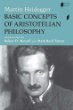
Basic Concepts of Aristotelian Philosophy (GA 18). Translated by Robert D. Metcalf and Mark B. Tanzer, Bloomington, Indiana University Press, 2009.
The much discussed Summer Semester 1924 Marburg lectures. Attending the course were Günther Anders, Hannah Arendt, Hans-Georg Gadamer, Hans Jonas, Karl Löwith, Jakob Klein, Leo Strauss, and Helene Weiss. Gadamer later wrote that these lectures wiped "away the scholastic overlay and serve as a model of a hermeneutical 'fusion of horizons,' which allowed Aristotle to come to language like a contemporary". The lectures focus largely on the Nichomachean Ethics and Rhetoric, interpreting the Aristotelian notions of λόγος, οὐσία, ἐντελέχεια, ἐνέργεια, and κίνεσις, through speaking, communicating, and being with one another, "not to say something new, but to say what the Ancients already intended." [P. 222]
The papers in Heidegger and Rhetoric are about this course.
Reviews:
Richard Polt
Joydeep Bagchee
Edward Willatt
The Basic Problems of Phenomenology (GA 24). Translated by Albert Hofstadter, Bloomington, Indiana University Press, 1982.
This is a lecture course presented at the University of Marburg during summer semester 1927. Heidegger looks at the philosophical history of ontology, with an emphasis on Kant in the first half, and then examines time as temporality and its relation to being. The material covered was intended for, the never published, division 3 of part 1, and part 2 of Being and Time.
In the first part of the course, Heidegger describes four theses about being in Western Philosophy.
In the second part of the course, he discusses the problem of the ontological difference via Aristotle's notion of time as a series of events, and temporality and being. In the introduction to the course, he introduces the ontological difference to describe ontology.
We said that ontology is the science of being. But being is always the being of a being. Being is essentially different from a being, from beings. How is the distinction between being and beings to be grasped? How can its possibility be explained? If being is not itself a being, how then does it nevertheless belong to beings, since, after all, being and only beings are? What does it mean to say that being belongs to beings? The correct answer to this question is the basic presupposition needed to set about the problems of ontology regarded as the science of being. We must be able to bring out clearly the difference between being and beings in order to make something like being the theme of inquiry. This distinction is not arbitrary; rather, it is the one by which the theme of ontology and thus of philosophy itself is first of all attained. It is a distinction which is first and foremost constitutive for ontology. We call it the ontological difference--the differentiation between being and beings. P. 17
Review: Andy Blunden

The Basic Problems of Phenomenology Winter Semester 1919/1920 (GA 58). Translated by Scott M. Campbell, London, Bloomsbury Academic, 2013.
Privatdozent Heidegger, in his second year of lecturing, examines how phenomenology, as a strict science, should approach the factical experience of life. Phenomenology should investigate factical life, in order to uncover the ground, "original science", of factical life. Factical life provides phenomenology with access, so that phenomenology can investigate that ground. By investigating through factical life, phenomenology can investigate the experience of life without objectifying it, as a science might. For examples of life experiences, Heidegger refers to Stephan George's poem "The Tapestry of Life", to Antigone, and to everday situations. He says that philosophers need to be evaluated with phenomelogy, and interpreted with respect to the ground of factical life. The works of Kant, Hegel, "those from Marburg", Bergson, William James, must be reckoned with.

Basic Questions of Philosophy Selected "Problems" of "Logic" (GA 45). Translated by Richard Rojcewicz and Andre Schuwer, Bloomington, Indiana University Press, 1994.
'First published in German in 1984 as volume 45 of Martin Heidegger's collected works, this book translates a lecture course he presented at the University of Freiburg in 1937-1940. Heidegger here raises the question of the essence of truth, not as a "problem" or as a matter of "logic", but precisely as a genuine philosophical question, in fact the one basic question of philosophy. Thus, this course is about the intertwining of the essence of truth and the essence of philosophy. On both sides Heidegger draws extensively upon the ancient Greeks, on their understanding of truth as aletheia and their determination of the beginning of philosophy as the disposition of wonder. In addition, these lectures were presented at the time that Heidegger was composing his second magnum opus, Beiträge zur Philosophie , and provide the single best introduction to that complex and crucial text.'

Basic Writings is on the anthologies page.
Becoming Heidegger has its own page.
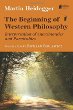
The Beginning of Western Philosophy Interpretation of Anaximander and Parmenides (GA 35). Translated by Richard Rojcewicz, Indiana University Press, 2015.
Lecture course from summer semester 1932. The course begins with an interpretation of Anximander's saying, similar to the essay on the saying from 1946 that was be published in Holzwege. Heidegger also examines Anazimander's dictum on the ἄπειρον through his ontological lens. The investigation of the bits of Anaximander that have come down to us, occupies twenty-five pages. In the next fifty pages Heidegger anticipates and responds to other scholars' reactions to his interpretation, and further elaborates it. Heidegger then turns to interpreting Parmenides's poem for the second half of the course, covering most of the extant fragments of the poem.
Being and Time has its own page.
Being and Truth (GA 36/37). Translated by Gregory Fried and Richard Polt, Indiana University Press, 2010.
Two lecture courses, The Fundamental Question of Philosophy, summer semester 1933, and On the Essence of Truth, the following winter. The sources are mainly attendees' transcripts.
The Fundamental Question of Philosophy is only sixty pages. It begins with questioning in Greek poetry, then touches the christianization of metaphysics, Descartes, Wolff's Ontology, Baumgarten, and ends philosophy with Hegel.
On the Essence of Truth, on Plato's cave allegory and Theaetatus, is a repeat of the same course given two year earlier. Yet, while the sections have similar names, Heidegger often discusses different aspects of the dialogues. As a rule, he never repeated courses, this one being the exception. The office of rector must have kept him busy.

Bremen and Freiburg Lectures Insight Into That Which Is and Basic Principles of Thinking (GA 79). Translated by Andrew J. Mitchell, Bloomington, Indiana University Press, 2012.
Insight Into That Which Is, is a series of four lectures delivered in Bremen, in December 1-2, 1949, and Basic Principles of Thinking was Heidegger's last lecture course at Freiburg, summer semester 1957.
The four Bremen lectures were: "The Thing", "Positionality", "The Danger", and "The Turn". Versions of some of these lectures were have been translated before: "The Thing" twice, "The Turn", and "Positionality", translated as "The Ge-Stell", and used in the 1953 lecture "The Question Concerning Technology". These lectures were Heidegger's first of public engagement since he had returned to teaching after his foray into university administration and politics in the early 1930s, and so they are the debut of the new directions in his questioning of being and the major themes of his later works.
The first of the Freiburg lectures was earlier translated as "Principles of Thinking", and the third as "The Principle of Identity" twice.The Bremen Lectures are probably the best bet for those who want an introduction to the later Heidegger from Heidegger himself. But the lectures will only make sense to someone who already knows B&T, and has the necessary ten years of Aristotle, and Nietzsche. If you only know about the hammer in the workshop, you're better off reading one of the excellent introductions to his later thought first.
Reviews:
Christopher D. Merwin

The Concept of Time (GA 64).
Translated by William McNeill, Oxford, Blackwell, 1992.
A lecture delivered to the Marburg Theological Society in 1924. Includes the German text on the facing page. A different translation appears in Becoming Heidegger.
Reviews:
D. R. Koukal

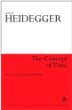
The Concept of Time The First Draft of Being and Time (GA 64).
Translated by Ingo Farin with Alex Skinner, London, Continuum, 2011.
Written in 1924, for the journal Deutsche Vierteljahresschrift fur Literaturwissenschaft und Giestesgeschichte, but not published.
Contributions to Philosophy has its own page.
Country Path Conversations (GA 77). Translated by Bret W. Davis, Bloomington, Indiana University Press, 2010.
Three dialogues written towards the end of World War II.
A quarter of the first dialogue was published in 1959, in revised form in Gelassenheit.

Discourse On Thinking. Translated by John M. Anderson and E. Hans Freund, New York, Harper & Row, 1966.
This is a translation of Gelassenheit, Verlag Günther Neske, 1959.
Contains:
The Memorial Address was delivered to the public in 1955. The Conversation--between a scholar, teacher, and scientist--is based on a longer dialogue written in the mid-1940s. That dialogue has been translated in the book above. There's an excerpt on Αγχιβασιη (Heraclitus, Fragment 122), here.

Duns Scotus's Doctrine of Categories and Meaning (GA 1). Translated by Joydeep Bagchee and Jeffrey D. Gower, Bloomington, Indiana University Press, 2022.
Heidegger’s Habilitationsschrift or postdoctoral thesis, University of Freiburg im Breisgau, in the spring of 1915.

Early Greek Thinking. Translated by David F. Krell and Frank A. Capuzzi, New York, Harper & Row, 1975.
Contains:
The fragments:

Elucidations of Hölderlin's Poetry (GA 4). Translated and introduction by Keith Hoeller, Amherst, New York, Humanity Books, 2000.
There's a bit on the center of the fourfold here.

The End of Philosophy. Translated and introduction by Joan Stambaugh, New York, Harper and Row, 1973.
Contains:
In the introduction the translator relates the ontological difference to Appropriation/Ereignis:
What does metaphysics, which Heidegger defines as the separation of essence and existence that began with Plato, have to do with the ontological difference of Being and beings? One might say that the tradition, particularly the medieval tradition, would equate these two distinctions. Being (esse) is the essence of beings, of what exists (existentia), the essence in the sense of the universal One which unifies everything. For Heidegger, the distinction essence-existence actually belongs in the tradition on the side of Being, but the difference between Being and beings, although constantly presupposed by all metaphysics, was never thought. Only when metaphysics reaches its completion does the possibility arise of transforming the ontological difference, of thinking it from the unthought presupposition of all metaphysics back to its essential origin in Appropriation.
Here's what overcoming means, in "Overcoming Metaphysics".

The Essence of Human Freedom (GA 31). Translated by Ted Sadler, London, Continuum, 2002. Second edition 2005.
In this course, presented at the University of Feiburg during winter semester 1930, Heidegger addresses first the meaning of being in Aristotle's Metaphysics, and then uses that as a basis to study freedom and causality in Kant's Critiques.
Reviews:
William McNeill,
Jonathan Derr,
Mark Blitz

The Essence of Reasons. Translated by Terrence Malick, Evanston, Northwestern University Press, 1969.
This essay was written in 1928, contemporaneously with What is Metaphysics?; both are included in Pathmarks. This book has the original German text on facing pages.
And yes, this was translated by Terrence Malick, the famous film director.

The Essence of Truth On Plato's Cave Allegory and Theaetatus (GA 34). Translated by Ted Sadler, London, Continuum, 2002.
This course, presented at the University of Freiburg during winter semester 1931-32, covers both an exploration of truth as unhiddeness via a close reading of the Allegory of the Cave from Plato's Republic, and a reading of the discussion of knowledge in the middle of Plato's Theaetetus.
NOTE: Continuum published a new edition in 2004, with different pagination!
Reviews:
William McNeill,
Mark Blitz,
Francesco Tampoia Tampoia

The Event (GA 71). Translated by Richard Rojcewicz, Bloomington, Indiana University Press, 2013.
From 1936 through 1940 Heidegger wrote Contributions to Philosophy, a fugue on six themes important to the thinking that would fill his remaining decades. The Contributions was followed over the next six years by notebooks in which Heidegger elaborated on its themes. In this period Heidegger developed the concerns that would fill his essays and lectures after the war. This series of books remained private, and were first published after Heidegger's death, as part of his complete works. The second book in the series was translated as Mindfulness, and this is the third to be translated, on the theme of Ereignis.
The table of contents gives a good indication of the matters that are pondered. There are 406 sections; some are several pages long and some only a sentence. New terms in this volume include Da-seyn, twisting free. Here's an excerpt on the difference and the event.
Reviews:
Miguel de Beistegui

Existence and Being is on the anthologies page.
Four Seminars (GA 15). Translated by Andrew Mitchell and François Raffoul, Bloomington, Indiana University Press, 2003.
Contains:
This book collects the three seminars (1966, 1968, 1969) Heidegger participated in at Le Thor, France, and the Zähringen seminar (1973), along with a couple ancillary papers. These are especially interesting because they are the last of Heidegger's "works", and because Heidegger is involved in thoughtful dialogue with others.
The seminars touch on familiar themes of presence and Ereignis, Heidegger's interpretations of Parmenides and Heraclitus, his reflections on Hegel's ideas and Husserl's Categorical Intuition, and he reaches out to the seminar participants by commenting on French artists and thinkers. He also criticizes aspects of his earlier works, including Being and Time.
The text of the seminars comes from the notes of the participants. First published in book form in France, the work was later translated to German and added to the Gesamtausgabe. As usual Indiana University Press and the translators have done an excellent job and created a first class English edition.
In 1969, at Le Thor, the seminar addressed Ereignis and thinking about place.

The Fundamental Concepts of Metaphysics World, Finitude, Solitude (GA 29/30). Translated by William McNeill and Nicholas Walker, Bloomington, Indiana University Press, 1995.
Heidegger's lecture course of winter semester 1929/30. Probably his most extended discussion of the theme of biological organisms and nature, along with the notion that "Man is World-forming". He also addresses the history of metaphysics, explains the essence of philosophy, and analyzes phenomenologically the mood of boredom, which he describes as a "fundamental attunement" of modern times, much like he used anxiety in Being and Time.
Heidegger makes nine points on the ontological difference.

Hegel (GA 68). Translated by Joseph Arel and Niels Feuerhahn, Bloomington, Indiana University Press, 2015.

Hegel's Concept of Experience (GA 5). With a section from Hegel's Phenomenology of Spirit. Translated by Kenley Royce Dove. San Francisco, Harper & Row, 1989.
Later translated in Off The Beaten Track.
In his comments on paragraph 15, on the science of the experience of consciousness, Heidegger relates Aristotle metaphysics to ontotheology.
The science Aristotle has described--the science that observes beings as beings--he calls First Philosophy. But first philosophy does not only contemplate beings in their beingness; it also contemplates that being which corresponds to beingness in all purity: the supreme being. This being, to qeion, the divine, is also with a curious ambiguity called "Being." First philosophy, qua ontology, is also the theology of what truly is. It should more accurately be called theiology. The science of beings as such is in itself onto-theological.
P. 135
Theiology is the study of the highest being, theion.

Hegel's Phenomenology of Spirit (GA 32). Translated by Parvis Emad and Kenneth Maly, Bloomington, Indiana University Press, 1988.
Lecture course from winter semester 1930-31, on Hegel's concepts of being, time, temporality, and dialectics.

Heidegger-Jaspers Correspondence 1920-1963. Edited by Walter Biemel and Hans Saner. Translated by Gary E. Aylesworth, Humanity Books, 2003.

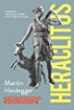
Heraclitus The Inception of Occidental Thinking and Logic; Heraclitus’s Doctrine of the Logos (GA 55). Translated by S. Montgomery Ewegen and Julia Goesser Assaiante, London, Bloomsbury Academic, 2018.
Reviews:
Shawn Loht [PDF],
Zühtücan Soysal
Heraclitus Seminar has its own page.
The Heidegger Reader is on the anthologies page.
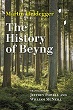
The History of Beyng (GA 69). Translated by William McNeill and Jeffery Powell, Bloomington, Indiana University Press, 2015.
History of the Concept of Time Prolegomena (GA 20). Translated by Theodore Kisiel, Bloomington, Indiana University Press, 1985.
This book has the lectures from a course Heidegger taught at the University of Marburg during the summer semester of 1925. In the first part Heidegger critiques Husserl's phenomenology, then he presents what is essentially Being and Time Division I and a bit of Division II.
Heidegger describes the key contributions of phenomenology (intentionality, categorical intuition, the original sense of the apriori) and then asks if phenomenology has really asked the ontological questions at its core.
In the section on Discoveredness he describes communication, not as the transmittal of information between two subjects, but as appropriation.
Communication accordingly means the enabling of the appropriation of that about which the discourse is, that is, making it possible to come into a relationship of preoccupation and being to that of which the discourse is. Discourse as communication brings about an appropriation of the world in which one always already is in being with one another. The understanding of communication is the participation in what is manifest.
It is not a matter of transporting information and experiences from the interior of one subject to the interior of the other one. It is rather a matter of being-with-one-another becoming manifest in the world, specifically by way of the discovered world, which itself becomes manifest in speaking with one another. Speaking with one another about something is not exchange of experiences back and forth between subjects, but a situation where the being-with-one-another is intimately involved in the subject matter under discussion. And it is only by way of this subject matter, in the particular context of always already being-with in the world, that mutual understanding develops.
P. 263

Hölderlin's Hymns "Germania" and "The Rhine" (GA 39). Translated by William McNeill and Julia Ireland, Bloomington, Indiana University Press, 2014.
This lecture course, presented at the University of Freiburg during winter semester 1934-35, is the first of the Hölderlin lectures; the others are GA 52 and GA 53. In it Heidegger first discusses themes he'll develop the following semester in Introduction to Metaphysics, and in "The Origin of the Work of Art" and Contributions to Philosophy. I believe this is his first use of beyng (Seyn) for a non-metaphysical sense of being, a spelling he appropriates from Hölderlin.
Heidegger is concerned with understanding the essence of Hölderlin's poetizing: "a thoughtful encounter with the revelation of beyng" (p. 5). With how poetic attunement can ground a people. The poet's waiting for the new gods: "a persistent waiting for and awaiting the event [Ereignis]" (p. 53). Nature understood as beyng: ""The beyng of the poet is grounded in "nature" (beyng as such), which says itself originarily in the poetizing" (p. 234).
Reviews:
Richard Polt

Hölderlin's Hymn "The Ister" (GA 53). Translated by William McNeill and Julia Davis, Bloomington, Indiana University Press, 1996.
This is a lecture course presented at the University of Freiburg
during summer semester 1942. The course is split into three parts.
First Heidegger looks for metaphysics in "The Ister",
then he returns to a passage of Sophocles' Antigone he had used,
more briefly, in a 1935 course, Introduction to Metaphysics.
Finally he examines more of "The Ister". Hölderlin's
poems have been translated especially for this book, to help
understand Heidegger's interpretation of the German.
In the first lecture Heidegger refers to Ereignis in poetry.
This distinctive significance of the "Now" demands that in this word of time we also come to hear something distinctly significant and await a concealed fullness of poetic time and so its truth. The "Now come" appears to speak from a present into the future. And yet, in the first instance, it speaks into what has already happened. "Now"--this tells us: something has already been decided. And precisely the appropriation that has already "occurred" [sich "ereignet"] alone sustains all relation to whatever is coming. The "Now" names an appropriative event [Ereignis].
Page 9
Heidegger remarks on the USA's entry into the war.
We know today that the Anglo-Saxon world of Americanism has resolved to annihilate Europe, that is, the homeland [die Heimat], and that means: the commencement of the Western world. Whatever has the character of commencement is indestructible. America's entry into this planetary war is not its entry into history; rather it is already the ultimate American act of American ahistoricality and self-devastation. For this act is the renunciation of commencement, and a decision in favor of that which is without commencement.
Page 54-55

Hölderlin's Hymn "Remembrance" (GA 52). Translated by William McNeill and Julia Ireland, Bloomington, Indiana University Press, 2018.
Lecture course at Freiburg winter semester 1941-1942. The lectures begin by describing Hölderlin's importance as a poet, and then explain the parts of Andenken that are of ontological relevance. Some of the themes collected in the later Fourfold are elaborated. Particularly interesting is the Ereignis of special events like the festival in the hymn.
Here are excerpts on the essence of history, night, and waiting to reflect.

Identity and Difference has its own page.
Introduction to Metaphysics has its own page.
Interpretation of Nietzsche's Second Untimely Meditation (GA 46). Translated by Ullrich Haase and Mark Sinclair, Bloomington, Indiana University Press, 2016.
Heidegger's seminar from WS 1940-39. Because there were so many participants that Heidegger essentially lectured throughout the seminar, this volume is considered a lecture in the Gesamtausgabe. Useful as preparation for some of the Nietzsche lectures in GA 6.2. Also interesting because of the discussion of justice.
Introduction to Phenomenological Research (GA 17). Translated by Daniel O. Dahlstrom, Bloomington, Indiana University Press, 2005.
Heidegger's first lectures at Marburg from winter semester 1923-1924. Phenomenolgy is introduced in terms of Aristotle, Descartes, and Husserl.
Introduction To Philosophy (GA 27). Translated by William McNeill, Bloomington, Indiana University Press, 2024.
Freiburg winter semester 1929-30.

Introduction To Philosophy — Thinking and Poetizing (GA 50). Translated by Phillip Jacques Braunstein, Bloomington, Indiana University Press, 2011.
In total, with afterwards, this book is only 74 pages because Heidegger was drafted into the Volksstrum shortly after the semester started. The other text in the GA 50, Nietzsche's Metaphysics, was not included in this book. It is apparently very similar to the text of the same title published in the Nietzsche collection.
Reviews:
Stuart Elden
Kant and the Problem of Metaphysics (GA 3). Translated by Richard Taft, Bloomington, Indiana University Press, 1997.
This book was first published in 1929, and is partially based on a lecture course from winter semester 1927-28, a lecture delivered in Riga in 1928, and lectures at Davos in March 1929. Several editions of this book were published over the years. This translation is based on the Gesamtausgabe edition, and includes several editions' prefaces and appendices.

Kant and the Problem of Metaphysics (GA 3). Translated by James S. Churchill, Bloomington, Indiana University Press, 1962.

Letters 1925-1975. Edited by Ursula Ludz, translated by Andrew Shields, Orlando, Harcourt Books, 2004.
Correspondence between Martin Heidegger and Hannah Arendt.
All the surviving written documents of the personal relationship between Arendt and Heidegger are presented here for the first time, from the Marbach papers of Arendt and Heidegger as well as from the Hannah Arendt Papers in Washington, D.C. They include 119 letters, postcards, and notes from him to her and 33 texts from her, many of which only survive as copies or drafts.
Reviews:
Adam Kirsch,
Simon Blackburn

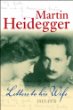
Letters to His Wife 1915-1970. Selected, edited and annotated by Gertrud Heidegger, translated by R. D. V. Glasgow, Cambridge, Polity Press, 2008.
Essentially what the title says, with additional helpful biographical notes and photographs unique to this volume.
Logic as the Question Concerning the Essence of Language (GA 38). Translated by Wanda Torres Gregory and Yvonne Unna, Albany, State University of New York Press, 2009.
Summer semester 1934.
Logic: The Question of Truth (GA 21). Translated by Thomas Sheehan, Bloomington, Indiana University Press, 2010.
Winter semester 1925 at Marburg, after which he went to the hut and wrote Being and Time. The fifty-three lectures can be considered in three parts. The first, the prolegomenon, is on psychologism (reducing logic to just the workings of the mind), Husserl's critique of it, and the need to return to Aristotle to ask the question of truth. The second is on λογος, humans' a priori need to make sense of things, and truth as uncoveredness in Aristotle's Metaphysics book Θ. The third part is an early draft of the Kant book that would be published in 1929.
Reviews:
Okla Elliott

The Metaphysical Foundations of Logic (GA 26). Translated by Michael Heim, Bloomington, Indiana University Press, 1984.
This is a lecture course, Logik, presented at the University of Marburg during summer semester 1928. In the first part of this course Heidegger examines Leibniz's Doctrine of Judgment. In the second he studies the Principle of Reason.
The Translator's Introduction to The Metaphysical Foundations of Logic by Martin Heidegger.

Metaphysics and Nihilism (GA 67). Translated by Arun Iyer, Cambridge, UK, Polity Press, 2022.
1 - The Overcoming of Metaphysics (1938/39)
2 - The Essence of Nihilism (1946-48)

The Metaphysics of German Idealism A New Interpretation of Schelling's Philosophical Investigations into the Essence of Human Freedom and the Matters Connected Therewith (1809) (GA 49). Translated by Ian Alexander Moore and Rodrigo Therezo, Cambridge, UK, Polity Press, 2021.

Mindfulness (GA 66). Translated by Parvis Emad and Thomas Kalary, London, Athlone, 2006.
The volume was written immediately following Contributions to Philosophy and is similar to it in content and style. There are 135 chapters, some a few sentences and others essay length, arranged in 28 sections. This translation also shares a translator with the Contributions, which is a good thing for consistency's sake, yet also revisits some of the issues with the previous translation: Seyn (beyng) is translated as be-ing, wesen (essence) as sway, and so on. The German title of this work is. The translators' reasons for chosing to translate the German title Besinnung into Mindfulness is explained here.
As with Contributions, some of the shorter chapters sound like mantras, or a catechism. For example, here's chapter 25:
Be-ing is the en-owning of truth.
Truth is the clearing of refusal, which in refusal and as refusal is a prime-leap--an out-lay of lighting up.
En-owning is the originary allotting of human beings both unto the truth (of be-ing) and thus, simultaneously, unto the distressing-need of the godhead of gods.
The strife of the world and the earth arises from within the en-ownment of enowning, and things that are in strife arise above all from that strife.
Page 82
The term mindfulness appeared in Contributions, but this is where Heidegger expands on it. He returns to familiar themes: truth, nothingness, enownment, ontological difference, art, the Greeks, Nietzsche, Spengler, and more, as well as commenting on his earlier texts. All are examined alongside mindfulness and some other themes that are here elaborated more fully: the withdrawal, the rupture and gathering, the dynamic inbetween, and the ab-ground (translated as abyss in other texts) that is not ground.
The books ends with two essays from the same period, A Retrospective Look at the Pathway and The Wish and the Will, and an editor's epilogue. Mindfulness was not left as a finished manuscript, but, as with Contributions, was compiled from a typescript and ancillary notes by Wilhelm von Herrmann, the designated director of the Gesamtausgabe.
In this excerpt, Heidegger responds to a statement by the Reich Chancellor with questions.
Reviews:
Miguel de Beistegui
Nature History State 1933-1934. Translated and edited by Gregory Fried and Richard Polt, Bloomsbury, 2015.
This seminar is not in the Gesamtausgabe.
Reviews:
Richard J. Elliott

Nietzsche I: The Will to Power as Art. Edited and Translated by David F. Krell, New York, Harper & Row, 1979.
Contains:
Lecture course from winter semester 1936-1937.
In this lecture course Ereignis appears as the "event of nihilism" during a discussion of Nietzsche's interpretation of Platonism, and why he had to overturn it.
Nietzsche's fundamental experience is his growing insight into the basic development of our history. In his view it is nihilism. Nietzsche expresses incessantly and passionately the fundamental experience of his existence as a thinker. To the blind, to those who cannot see and above all do not want to see, his words easily sound overwrought, as though he were raving. And yet when we plumb the depths of his insight and consider how very closely the basic historical development of nihilism crowds and oppresses, then we may be inclined to call his manner of speech almost placid. One of the essential formulations that designate the event of nihilism says, "God is dead." The phrase "God is dead" is not an atheistic proclamation: it is a formula for the fundamental experience of an event in Occidental history.
...
By nihilism Nietzsche means the historical development, i.e. event, that the uppermost values devalue themselves, that all goals are annihilated, and that all estimates of value collide against one another.
P. 156
Nietzsche II: The Eternal Recurrence of the Same. Edited and Translated by David F. Krell, New York, Harper & Row, 1984.
Contains:
Nietzsche III: The Will to Power as Knowledge and Metaphysics. Edited by David F. Krell, translated by Joan Stambaugh, Frank A. Capuzzi, and David F. Krell, New York, Harper & Row, 1987.
Contains:
Nietzsche IV: Nihilism. Edited by David F. Krell, translated by Frank A. Capuzzi, New York, Harper & Row, 1982.
Contains:
The ontotheology in Nietzsche's thought is explained with reference to earlier scholasticism:
As an ontology, even Nietzsche's metaphysics is at the same time theology, although it seems far removed from scholastic metaphysics. The ontology of beings as such thinks essentia as will to power. Such ontology thinks the existentia of beings as such and as a whole theologically as the eternal recurrence of the same. Such metaphysical theology is of course a negative theology of a peculiar type. Its negativity is revealed in the expression "God is dead." That is an expression not of atheism but of ontotheology, in that metaphysics in which nihilism proper if fulfilled.
P. 210
Reviews:
Harry Neumann
 Nietzsche III & IV
Off The Beaten Track (GA 5). Edited and Translated by Julian Young and Kenneth Haynes, Cambridge University Press, 2002.
Contains:
Published in Germany as Holzwege in 1950. "The Origin of the Work of Art" are three lectures presented in Frankfurt at the Freien Deutschen Hochstift on the 17th and 24th of November, and 4th of December 1936.
Appendix 8, on Protagoras and metaphysics, is excerpted on the blog enowning.

On Hegel's Philosophy of Right (GA 86). Translated by Andrew J. Mitchell, Bloomsbury, 2014.

On Inception (GA 70). Translated by Peter Hanly, Bloomington, Indiana University Press, 2023.
Reviews:
Shawn Loht

On My Own Publications (GA 82). Translated by Scott M. Campbell, Indiana University Press, 2025.
On the Essence of Language (GA 85). Translated by Wanda Torres Gregory and Yvonne Unna, Albany, State University of New York Press, 2004.
A seminar on Herder's On the Origin of Language in 1939.

On the Essence of Language and the Question of Art (GA 74). Translated by Adam Knowles, Albany, State University of New York Press, 2004.
Treatises from the 1940s.

On the Way to Language has its own page.
On Time and Being has its own page.
Ontology: The Hermeneutics of Facticity (GA 63). Translated by John van Buren, Bloomington, Indiana University Press, 1999.
From Heidegger's lectures at the University of Freiburg during the summer semester of 1923. He begins the lectures by reviewing the history of hermeneutics, beginning with the use of the root words by Plato and Aristotle. He examines the concept of man in theology, and man as the one that is reason, λόγον ἔχον, then follows with descriptions of hermenutics as historical interpretation and its role in phenomenology.
Referring to the title the translator explains:
Heidegger's course is "ontology" because it investigates the "be-ing" (Sein) of facticity and more concretely the "be-ing there" (Dasein) of factical human Dasein and its world and even more concretely the be-ing there of factical Dasein and its world in the "awhileness of their temporal particularity" (Jeweiligkeit).
P. 91
The translator is the author of The Young Heidegger, and editor of Reading Heidegger from the Start and Supplements.
A discussion of a table as phenomena is excerpted here.

Parmenides (GA 54). Translated by Andre Schuwer and Richard Rojcewicz, Bloomington, Indiana University Press, 1992.
This is a lecture course, Parmenides and Heraclitus, presented at the University of Freiburg during winter semester 1942-1943. Heidegger examines Parmenides's poem and the question of truth. Towards the end he notes that the Greek understanding of truth is critical to Western history.
The primordial essence of truth is alhJeia not because the Greeks were visual, but instead the Greeks could only be visual because it is alhJeia that determines the relation of their humanity to Being. This and only this, namely that the essence of truth originates as alhJeia, but precisely in such a way as to conceal itself forthwith, is the event of the history of the Occident.
P. 147

Pathmarks has its own page.
Phenomenological Interpretations of Aristotle Initiation into Phenomenological Research (GA 61). Translated by Richard Rojcewicz, Bloomington, Indiana University Press, 2001.
A lecture course from winter semester of 1921-22, at Freiburg. Heidegger's first discussion of factical life and its relation to care, and the beginning of a phenomenological interpretation of Aristotle. It is a beginning in the sense of an introduction (the title in the entire course, according to the table of contents), a laying down of the ground for an interpretation. As is often the case in his lectures, after he interprets the course title and what questions it elicits, and in this case some descriptions of how Aristotle has been interpreted, Heidegger uses the lecture course to discuss where his thinking is headed. The initiation is the sub-title correctly indicates that this is about the basis for phenomenology. This course is especially value for its elaborations of the sense of "care" that will figure in Being and Time.
Here's a paragraph on interpreting event as occurence.

Phenomenological Interpretation of Kant's Critique of Pure Reason (GA 25). Translated by Parvis Emad and Kenneth Maly, Bloomington, Indiana University Press, 1997.
Winter semester 1927-28 lecture course on Kant's book.

Phenomenology of Intuition and Expression Theory of Philosophical Concept Formation (GA 59). Translated by Tracy Colony, London, Continuum, 2010.
Lecture course presented at the University of Freiburg during summer semester 1920.

The Phenomenology of Religious Life
(GA 60).
Translated by Matthias Fritsch and Jennifer Anna Gosetti-Ferencei, Bloomington, Indiana University Press,
2004.
This book contains the lectures from two courses at Freiburg, Introduction to the Phenomenology of Religion from winter semester 1920 and Augustine and Neoplatonism from summer semester 1921. In addition there are twenty pages of notes for a course on The Philosophical Foundations of Medieval Mysticism that was not held because Heidegger decided to lecture on another subject in winter semester 1919.
In the first course, Heidegger concentrates his exegesis on Paul's letters to the Thessalonians, and in second, on Augustine's Confessions Book X.
Reviews:
Sean J. McGrath

Philosophical and Political Writings is on the anthologies page.
The Piety of Thinking. Translated by James G. Hart and John C. Maraldo, Bloomington, Indiana University Press, 1976.
This book has sixty pages by Heidegger -- the list below -- plus an additional 150 pages of commentary from the translators.
There's a bit of the conversation recorded at the Protestant Academy at Hofgeismar here. There is a more recent translation of "Principles of Thinking".

Plato's Sophist (GA 19). Translated by Richard Rojcewicz and Andre Schuwer, Bloomington, Indiana University Press, 1997.
Heidegger's lecture course at the University of Marburg in the winter semester of 1924-25, devoted to an interpretation of Plato and Aristotle. The first part of the lectures to an extended commentary on Book VI of Aristotle's Nichomachean Ethics, folowed by a line-by-line interpretation of Plato's dialogue.
Reviews:
Clifford Angell Bates, Jr.,
Jasmin Chen,
Walter Brogan

Poetry, Language, Thought. Translated by Albert Hofstadter, New York, Harper & Row, Harper Colophon edition, 1971.
Contains:
The publishers have released several editions with different covers. The publisher changed the pagination in the 2001 Perennial Classics edition confusing citations.
In the introduction the translator discusses the fourfold (earth, sky, gods, mortals) and Ereignis, and its translation.
Thus ereignen comes to mean, in his writing, the joint process by which the four of the fourfold are able, first, to come out into the light and clearing of truth, and thus each to exist in its own truthful way, and secondly, to exist in appropriation of and to each other, belonging together in the round dance of their being; and what is more, this mutual appropriation becomes the very process by which the emergence into the light and clearing occurs, for it happens through the sublimely simple play of their mutual mirroring. The mutual lighting-up, reflecting, eräugnen, is at the same time the mutual belonging, appropriating, ereignen; and conversely, the happening, das Ereignis, by which alone the meaning of Being can be determined, in this play of eräugnen and ereignen; it is an Eräugnen which is an Ereignen and an Ereignen which is an Eräugnen.
Is is because of this interpenetrating association of coming out into the open, the clearing, the light--or disclosure--with the conjunction and compliancy of mutual appropriation, that I have ventured to translate "das Ereignis," in the Addendum to "Origin," not just as "the event," "the happening," or "the occurence," but rather as "the disclosure of appropriation." This translation has survived the critical scrutiny of Heidegger himself, as well as J. Glenn Gray and Hannah Arendt, and therefore I repose a certain trust in its fitness.
P. xxi
In an addendum to "The Origin of the Work of Art" Heidegger indicates that art belongs to Ereignis.
Reflection on what art may be is completely and decidedly determined only in regard to the question of Being. Art is considered neither an area of cultural achievement nor an appearance of spirit; it belongs to the disclosure of appropriation by way of which the "meaning of Being" (cf. Being and Time) can alone be defined.
P. 86
"The Thing" was also translated in the Bremen Lectures.

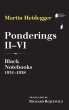
Ponderings II-VI Black Notebooks 1931–1940. (GA 94). Translated by Richard Rojcewicz, Bloomington, Indiana University Press, 2014.
Ponderings VII-XI Black Notebooks 1940–1939. (GA 95). Translated by Richard Rojcewicz, Bloomington, Indiana University Press, 2017.
Reviews:
Gregory Fried

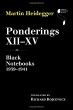
Ponderings XII-XV Black Notebooks 1939–1943. (GA 96). Translated by Richard Rojcewicz, Bloomington, Indiana University Press, 2017.
The Principle of Reason. (GA 10). Translated by Reginald Lilly, Bloomington, Indiana University Press, 1991.
A lecture course from winter semester 1955-56 that focuses on Leibniz's principle that nothing is without reason. Also included is an address with the same name that Heidegger delivered in 1956.

The Question Concerning Technology and Other Essays . Translated by William Lovitt, New York, Harper & Row, 1977.
Contains:
The first essay is one of Heidegger's most popular, showing up in many humanities courses about technology. That's generally a good thing because the essay starts with Aristotle's theory of forms, which will likely be most students first introduction to his Metaphysics. Heidegger then explores the different meanings of the Greek techne and its evolution to the modern term technology, and how the changes reflect how human's thinking has changed since Aristotle's Athens.
"The Turning" in this book is a translation of the version published in 1957 in Identität und Differenz. It differs slightly from the original delivered in 1949's Bremen lecture (GA 79).

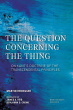
The Question Concerning the Thing On Kant's Doctrine of the Transcendental Principles (GA 41). Translated by James D. Reid and Benjamin D. Crowe, London, Rowman & Littlefield, 2018.
Previously translated as: What Is a Thing?.
The Question of Being. Translated by Jean T. Wilde and William Kluback, Albany, New York, New College University Press, 1958.
Also in Pathmarks.

Remarks I-V Black Notebooks 1942–1948 (GA 97). Translated by Adam Knowles, Bloomington, Indiana University Press, 2025.

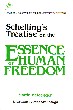
Schelling's Treatise on the Essence of Human Freedom. (GA 42). Translated by Joan Stambaugh, Athens, Ohio University Press, 1984.
Lecture course from summer semester 1936. This translation is of the pre-GA Niemeyer book.
Sojourns The Journey to Greece. (GA 75). Translated by John Panteleimon Manoussakis, Foreword by John Sallis, Albany, State University of New York Press, 2005.
Heidegger takes a cruise ship with a friend around the Aegean, visiting many popular ancient sites. Visting the island of Delos leads him to the following reflection.
Every saying and, through it, every creation and work, every deed and action receives from ἀλήθεια and retains in it the determination of their type. For ἀλήθεια is this place [Bereich]: the open space that is taking place [sich darreichende] and gives place [erreichende] to every thing, that determines and liberates, that allows what is present and absent to come and last, to leave and err.
P. 32

Supplements From the Earliest Essays to Being and Time and Beyond. Edited by John van Buren, Albany, State University of New York Press, 2002.
Contains:

Thought Poems A Translation of Heidegger’s Verse (GA 81). Translated by Eoghan Walls, London, Rowman & Littlefield, 2021.

Towards the Definition of Philosophy (GA 56/57). Translated by Ted Sadler, London, Continuum, 2002.
This volume brings together the two lecture courses of 1918-- The Idea of Philosophy and the Problem of Worldview, and Phenomenology and Transcendental Philosophy Value--as well as the lecture, On the Nature of the University and Academic Study.
In 2008 a corrected and expanded edition was published.
The first lecture course is from the Kriegsnotsemester, emergency war semester, following WWI. It has the earliest reference to Ereignis that I have found.
I ask: 'Is there something?' The 'is there' is a 'there is' for an 'I', and yet it is not I to and for whom the question relates.
A wealth of quite new problem-connections is loosened up: problems to be sure, but on the other hand matters of immediate intuition that point to new contextures of meaning. However simply and primitively the interrogative experience gives itself, in respect of all its components it is peculiarly dependent. Nevertheless, from this experience aground-laying and essential insight can now be achieved. (Characterizations of the lived experience as event [Er-eignis]--meaningful, not thing-like.)
P. 58
Heidegger begins to talk about his lectern, how his students and he 'see' it, and how someone who has never seen a lectern before would 'see' it. Then he contrasts how astronomers look at sunrise to how the Theban chorus in Sophocles' Antigone experiences sunrise after successfully defending Thebes from the invading army from Argos. Then he returns to the lectern.
In seeing the lectern I am fully present in my 'I'; it resonates with the experience, as we said. It is an experience proper to me and so do I see it. However, it is not a process but rather an event of appropriation [Er-eignis] (non-process, in the experience of the question a residue of this event). Lived experience does not pass in front of me like a thing, but I appropriate [er-eigne] it to myself, and it appropriates itself according to its essence. If I understand it in this way, then I understand it not as process, as thing, as object, but in a quite new way, as an event of appropriation.
P. 63
After the above, Heidegger does not use Ereignis as appropriation until after Being and Time.

Vigils and Nocturne Black Notebooks 1952/53–1957 (GA 100). Translated by David C. Abergel and Scott M. Campbell, Bloomington, Indiana University Press, 2025.

What is a Thing? (GA 41). Translated by W. B. Barton, Jr. and Vera Deutsch, Chicago, Henry Regnery Company, 1967.
This is from a lecture course at Freiburg in winter semester, 1935-36, entitled "Basic Questions of Metaphysics".
Heidegger uses a particular definition of the mathematical.
The mathematical (mathemata, what is learnable) is that evident aspect of things within which we are always already moving and according to which we experience them as things at all, and as such things... the mathematical is the fundamental presupposition of the knowledge of things.
P. 75
Recently re-translated as: The Question Concerning The Thing.
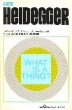
What Is Called Thinking? (GA 8). Translated by Fred D. Wieck and J. Glenn Gray, New York, Harper & Row, 1968.
Lectures delivered at the University of Freiburg during the winter and summer semesters of 1951-2.
Lecture VI has some advice to neophyte philosophers.
From all that has been suggested, it should be clear that one cannot read Nietzsche in a haphazard way; that each one of his writings has its own character and limits; and that the most important works and labors of his thought, which are contained in his posthumous writings, make demands to which we are not equal. It is advisable, therefore, that you postpone reading Nietzsche for the time being, and first study Aristotle for ten to fifteen years.
P. 73
There a bit on why rationalism can't answer the question here.

What Is Philosophy? (GA 11) Translated by Jean T. Wilde and William Kluback, New Haven, College and University Press, 1958.
This is lecture given at Cerisy-la-Salle, Normandy, in August 1955. The lecture has been excerpted in the What is Philosophy? posts on the enowning blog.
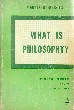
What Is That – Philosophy? (GA 11) Translated and annotated by Eva T. H. Brann, St. John's College, Annapolis, Maryland, 1991.
Zollikon Seminars (GA 89) Edited by Medard Boss Translated by Franz K. Mayr and Richard R. Askay, Evanston, Illinois, Northwestern University Press, 2001.
This translation is of the German book published in 1987. The Gesamtausgabe edition has additional material from the seminars.
The first half of this book is the actual seminars conducted by Heidegger at Dr. Medard Boss's home in Zollikon, mostly between January, 1964 and March, 1966. The rest of the book is records of Boss and Heidegger's conversations and their correspondence.
In one conversation, Heidegger explains why dasein is necessary for the clearing where things come into presence.
Presencing is [how] the being of beings has been determined since ancient times. Not only in ancient times, but also in modern times, objectivity [Objektivität], standing against[Gegenständigkeit], present-at-handness [Vorhandenheit], and presentness [Präsenz] are simply modifications of presencing.
There is no presencing without a "where-to" [Wohin] of such presencing and tarrying [Verweilen]--of tarrying on [An-weilen]; that is, it is a tarrying [Weilen] which approaches what lets itself be approached [i.e., Da-sein]. If there were not such a being [i.e., Da-sein] letting itself be approached, nothing could come to presence.
The human being is the guardian of the clearing, of the disclosive appropriating Event [of being]. He is not the clearing himself, not the entire clearing, nor is he identical with the whole of the clearing as such. But as the one ecstatically "standing out" into the clearing, he himself is essentially cleared [gelichtet], and thus cleared himself in a distinguished way. Therefore, he is related to, belongs to, and is appropriated by the clearing. Da-sein's being needed as the shepard of the clearing in a distinguished manner of belonging to the clearing.
P. 177-178
In a conversation on September 7, 1963, Medard's shorthand recorded Heidegger contrasting Ereignis to "being understood as presence."
As long as one understands being as presence as it was once understood and is still [understood], one cannot understand technology and surely not the disclosive appropriating Event at all.
The determination of what was designated in metaphysics as what is present [da Anwesende], the res, is [re]thought in the new interpretation of a thing (as presented in the lecture What Is a Thing?) from [the background of] the disclosive appropriating Event. In this interpretation of a thing, presence as the [metaphysical] determination of being is abandoned.
P. 182
That excerpt is expanded on in a comparison of the phenomenological and psychoanalytical method.
Here's some more on the Da and the clearing.
Reviews: Daniel Dahlstrom

Back to Heidegger books page.
Back to Heidegger home page.
 Nietzsche I & II