
Pictures of book covers link to the book at Amazon. Required verbiage: “As an Amazon Associate I earn from qualifying purchases.”
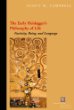
The Early Heidegger's Philosophy of Life Facticity, Being, and Language. Scott M. Campbell, New York, Fordham University Press, 2012.
This follows Heidegger's lectures from his first at Freiburg, during the KNS semester in 1919, to the Sophist course at Marburg in 1924. The guiding theme is Heidegger's development of the concept of facticity.
Heidegger first uses the term "facticity", as distinct from "factical life", at the end of summer semester 1920. Facticity describes what always already is, the self's original reality. The pretheoretical lived experience that science begins to try to explain. In his next course, Heidegger turns to religion and Paul, using facticity to describe the dynamic experience of life and its historicality.
In 1921 the focus on Aristotle and phenomenology begins, and Heidegger calls facticity "the main point of philosophy." He emphasizes how examining the phenomenon of life is different from philsophy's traditional concerns. In 1922 Heidegger writes a manuscript for a proposed book on Aristotle, and in the summer semester's course, his last before departing for Marburg, explores factical life's way of being in the world, the there of Dasein. Heidegger questions factical life with hermeneutical ontology, and studies it in its average everydayness.
At Marburg Heidegger turns to Aristotle concept of λόγος and the facticity of language, which not only reveals things, but also conceals them. The next semester is the study of Aristotle's Rhetoric, and the semester after that Plato's Sophist (1924-25). Each course has a chapter devoted to it, following Heidegger's development of facticity on the way to Being and Time.
Written a generation after Kisiel and Van Buren's original studies of Heidegger's path to Being and Time, this volume gathers much of the recent research, and is the best account of Heidegger's early work.
Reviews: Daniel L. Tate Gert-Jan van der Heiden
The Genesis of Heidegger's Being & Time. Theodore Kisiel, Berkeley, University of California Press, 1993.
The is one of the best works of Heidegger scholarship. It traces the origins of Heidegger's way of thinking from his dissertation up to the final draft of Being and Time. 450 pages of text followed by useful supplementary information including several indices and a glossary of terms.
The book examines many of Heidegger's early lectures. Here is how it paraphrases the moment during the Kriegsnotsemester lecture course when Heidegger reflects on his experience of his lectern.
It is my proper experience because it appropriates me and I, in accord, appropriate it. I am It, I am of It, It is mine. This experience is accordingly not a process but rather an event proper to me, a properizing event (Ereignis).
P. 46
Here is what the glossary has to say about Ereignis:
Ereignis (properizing event, appropriating event)--Clearly destined from the start to be the central "terminus technicus" of Heidegger's entire Denkweg to identify the very source and "primal leap" (Ur-sprung) of experience, this etymologically rich term nevertheless goes into dormancy for almost a decade after its initial thematization in KNS 1919 and SS 1919, replaced during that period by the Christian and Greek kairological sense of time as the Moment. Er-eignis is first introduced in KNS as the central characterization of the most intense lived experience (Er-leben) of the historical I in close conjunction with the meaning-bestowinging dynamics of the It which "worlds" (ZBP 69, 74f.). The I is fully there in the "It worlds" of the primal something such that "I myself properize (Er-eigne) It to myself and It properizes (Er-eignet) itself according to its essence" (75). This intimate involvement with the primal It of Being thus prompts the distiction between events which "happen" (passieren: ZBP 205) to me passionally and move me by situating me, and processes (Vorgänge) which passes before me objectively. The KNS-Schema accordingly distinguishes the sheer indifference of the formal-objective "something in general" from the pretheoretical preworldly "primal something" which is the "index of the highest potentiality of life" in and for itself (ZBP 115).
In BT, however, the occasional use of Ereignis at least in the two extant Divisions returns to its mundane sense of objectified and reified impersonal historical events past and gone (SZ 250, 253, 257, 284, 290, 378, 382, 389). It is only in SS 1928 that a tendency back to its originally intimate sense begins to assert itself: in a redescription of ecstatic and horizontal temporality, primal time, and primal history as understood dynamically as a generative temporalizing which "worlds", as an "es gibt" which yields the "nihil originarium" of a world (GA 26:270/209, 272/210). This is more ontically described as "the Ereignis of the world-entry of beings" (274/212), or the Urereignis which is essentially generative temporalizing. Some advance is made in articulating this primal event in the concurrent seminar of SS 1928 on Aristotle's Physics, where, in order to express the incomplete "underway" character of movement, dynamis (capability, power) is translated more phronetically as Eignung (aptitude, suitability), and the question is then posed how this adaptation to..., approrpaiteness for..., determines the Ereignung of generative movement, the primal event of human history. Much like the formal indication of ex-sistence in BT, accordingly, the focus of Aristotle's energeia ateles (in 1928 still meant for the Third Division of the never published Second Part of BT) reverses the dominant Greek sense of finished being, pointing instead to the generative event which possibilizes actuality in the absence of presence welling up from the concealment of unconcealment (so in the later Heidegger).
Glossary
kairological: human, non-objective time
KNS: Kriegsnotsemester
SZ: Sein und Zeit
ZBP: GA 56/57

Heidegger - Index (1919-1927). Robert Petkovsek,
Theological Faculty of the University of Ljubljana, 1998.
This book is an exception to the site's English only rule.
Apart from a preface in Slovenian, the book is essentially
in German and Greek, indexing words to the GA. Invaluable
to serious scholars.
Heidegger's Way of Thought Critical and Interpretative Signposts.
Theodore Kisiel.
Edited by Alfred Denker and Marion Heinz,
London, Continuum, 2002.
Contains:
In the essay on Emil Lask, the author refers to Heidegger's lectures from 1919 and the appearance of Ereignis:
This is vintage Heidegger already in early 1919 (March 21), openly pronouncing for the first time -- and surprisingly quite early -- his very last word for Being at the end of his career of thought, the singulare tantum of das Ereignis. Later more explicitly tied to the ecstatic and expansive 'reach' of time, the properizing event was, is and remains through and through the very contextualizing (later called 'regioning') of that expanse of meaning that we call the world.
P. 18
Reviews: Richard Polt Frank Edler
Iain MacKenzie

Reading Heidegger From the Start. Edited by Theodore Kisiel and John van Buren, Albany, State University of New York Press, 1994.
Contains:

Heidegger's Religious Origins Destruction and Authenticity. Benjamin D. Crowe, Bloomington, Indiana University Press, 2005.
Heidegger began his studies intending to become a priest before finally settling on philosophy. Early on he studied Agustine, Aquinas, Luther, and Christian hermeneutics. How important were his theological studies in defining his philosophy? This book argues that Heidegger's understanding that philosophy is based on the factical life, the world dasein is embedded in, derives from his religious studies. He realized that a primal, Net Testament, Christianity had been obscured by Platonic philosophy and Scholasticism. One intriguing claim is that the destruction of Being and Time has its origins in Luther's term destructio. After an introduction to Heidegger religious background, this book the most in depth discussion of Heidegger's term authenticity, where it came from and what he meant by it. I found this paragraph particularly helpful:
"Inauthenticity" (like its cognates) is not a name for a concept. Instead, it is a "formal indication" that is intended by Heidegger to intimate a complex pattern that is found in life as it is lived. That is, the term "inauthenticity" is used to mark off, in a general way, the boundaries of a certain way of being a human being. The term itself, Un-eigentlichkeit, gives one a clue as to the most basic feature of this way of life. 'Eigentlichkeit,' rendered literally, means something like "being owned" or "being proper to one." Heidegger uses the root, 'eigen', to refer to the irreducible singulairty of human life. Un-eigentlichkeit, then, hints at a way of life that has somehow or other relinquished its singularity by failing to "own" up to it.
P. 99
The final two chapters describe how and why Heidegger used the term destruction as the proper task of philosophy.

The Young Heidegger. John Van Buren, Bloomington, Indiana University Press, 1994.
What did Heidegger think and when did he think it? This book first evaluates what Heidegger said about the origins of his way of thinking and then examines what Heidegger wrote during his student years and early lectures looking for the origins of what would become Heidegger's main themes.
There is a chapter titled Ereignis that revolves around the Kriegsnotsemester lectures.
The out-toward of the primal something into specific worlds is what Heidegger meant by Ereignis. The "worldish something" of the ancient Greek sunrise or of the twentieth-century lectern "e-vents/en-owns itself according to its essential presencing." The student transcripts of this course describe the Ereignis of the primal preworldly something as a "to world-out [auszuwelten] iunto specific lifeworlds" (DK 113). This Ereignis of being is also described as a temporal there is/it gives worlds. In the phrase "it e-vents/en-owns itself," the nonpersonal "it" that encompasses the personal I is precisely the Ereignis of the primal something, of being, of worlds.
P. 274
There's more from this chapter here.
Glossary
DK: Theodore Kisiel's "Kriegsnotsemester 1919: Heidegger's Hermeneutic Breakthrough"

Back to Heidegger books page.
Back to Heidegger home page.