Thomas Sheehan
The major obstacle in interpreting Heidegger today is the continued use of the ontological language of “being” and “beings.” If Heidegger’s work is to have the philosophical impact it deserves, scholars must realize that throughout his texts the term “being” was only a provisional and ultimately misleading way of saying “meaning,” just as “time” was a first and inadequate attempt to name “the disclosure of meaning to understanding.”1
This essay argues that throughout his writings Heidegger presupposed a phenomenological reduction of being to meaning. It then tests that thesis by re-interpreting two crucial terms in Heidegger’s philosophy: Ereignis in the later period and facticity in the earlier, both of which come down to the same thing: the a priori appropriation of man to the meaning-process.
Some conventions in this essay: I use “man” and “human being” as gender-neutral and as the most formal of indications of what Heidegger means by Dasein.2 Both English terms translate the Greek ἄνθρωπος, understood by Heidegger as Dasein, the only place where meaning shows up. Secondly, after a few introductory paragraphs, I will translate Sein as meaning or meaning-giving;3 and in this essay I will not distinguish between sense and meaning. Thirdly, I will translate Erschließung, Erschlossenheit, Unverborgenheit, and Wahrheit as “disclosure [of meaning] to understanding,” lest the correlation of disclosure and understanding be overlooked. Finally, to designate the earlier and the later Heidegger, I will occasionally use William J. Richardson’s helpful shorthand terms: Heidegger I (the early Heidegger, 1919 to 1930) and Heidegger II (the later Heidegger, 1930 to 1976).
Everyone is used to hearing that “being” (Sein) is Heidegger’s core topic, but that is wrong on two accounts.
First, being is always the being of beings, whereas Heidegger insisted that the being of beings was not the central issue of his thinking. (Metaphysics had already covered that ground.) Instead, prescinding from its function of grounding beings, Heidegger asks how being itself occurs at all. This question can be expressed in various ways, for example: What is the Wesen or Wahrheit or Ursprung of Sein? (i.e., the source of the disclosure of being to understanding), or simply “Wie west das Sein?” – “How does the being-process occur?” In some of Heidegger’s later works, the various titles for naming that source tend to cluster around the key term Ereignis.4
The second reason why “being” is not Heidegger’s core topic is that once one has taken the phenomenological turn, the only philosophical issues that remain are questions of meaning.5 To gloss Gadamer’s bon mot: Being that can be understood is meaning.6 Our ability to deal with anything we encounter, our capacity to make sense of it, entails that the thing must have already entered the realm of language – that is, the realm of meaning. And meaning, of course, occurs only in correlation with human understanding. This correlation is itself the disclosure of meaning to understanding. Therefore, Gadamer’s sentence correctly implies a phenomenological reduction of “being” to “meaning,” and of “is” to “makes sense as.”7 And for human beings the wonder of all wonders, the θαῦμα that causes us to θαυμάζειν is, as Heidegger says, that things make sense and do so without being constituted by a Husserlian transcendental ego.8
Husserl had already made it clear that within the phenomenological reduction things remain the same as they were before.
We should not overlook the most essential thing of all, namely that even after [the phenomenological reduction’s] purifying epoché, perception still remains perception of this house, indeed, of this house with the accepted status of “actually existing.”9
What the reduction does is to refrain (ἐπέχειν) from considering the house as just “existing out there.” Instead, it leads the phenomenologist’s gaze “back from” the existing thing (re-ducere; zurück-führen) and directs it to one’s hermeneutical (sense-making) relation to that thing. This is especially true of Heidegger’s phenomenology, with its focus on the hermeneutical structure of human being. So it is quite incorrect to say that, given its strong focus on everyday practical activity, Heidegger’s early phenomenology operates within the “natural attitude” that Husserl’s epoché brackets out. Rather, everything that Heidegger has to say about tool-use in Being and Time is said exclusively within a phenomenological reduction to the hidden hermeneutical structure of our sense-making relation to things.
And then, following the phenomenological reduction, the phenomenologist poses a further question, this time about the constituting source of meaning-giving as such. This source is not anything “behind” the And then, following the phenomenological reduction, the phenomenologist poses a further question, this time about the constituting source of meaning-giving as such. This source is not anything “behind” the meaning of the thing but is simply the disclosive correlation of man and meaning as such. “Meaning and its disclosure to understanding are of co-equal and simultaneous origin.”10 Therefore, in both reductions of focus – from being to meaning, and from meaning to its constituting source – the outcomes are always a matter of correlation. In the first reduction the phenomenologist’s focus is on the intentional correlation between understanding and the thing. In the second reduction, the phenomenological gaze focuses on one’s transcendence to meaning (= one’s a priori engagement with it), a correlation that is the source of meaning-giving. In neither reduction does Heidegger trace matters back to a transcendental ego à la Husserl, but rather always and only to the sense-making structure of concrete human existence as ineluctably engaged with meaning (In-der-Welt-sein). In other words, (a) the meaningful within the context that gives it meaning, (b) in correlation with the human engagement with meaning-giving – this is Heidegger’s rewrite of the so-called object and subject poles of the phenomenological correlation. And this is definitively Heidegger, not Husserl, because the so-called subject pole is not consciousness but Dasein, the hermeneutical essence of human being.11 As we shall see below, this correlation is what Heidegger means by Ereignis.
One might object, however, that in his 1927 lecture course Basic Problems of Phenomenology, Heidegger designates his own version of the phenomenological reduction as the shift of the philosopher’s gaze from “beings” (Seiendes) to their “being” (Sein) rather than to their meaning. He argues that the phenomenologist must begin with things, but always and only in an effort to thematize their Sein.
The apprehension of being (i.e., an ontological investigation) always focuses first of all, and necessarily so, on something that is in being. But then one’s focus decisively shifts away from the thing and is led back to the thing’s being. This basic element of phenomenological method – understood as leading the researcher’s gaze from naïvely understood things to their being – is what we designate as the phenomenological reduction. (GA 24: 28.32–29.4 = Basic Problems of Phenomenology, 21.13–18)
Yes – but it is clear that for Heidegger this is a reduction from the naive, natural-attitude understanding of a being to a thematically focused understanding of its being. But being that is understood is meaning. In fact, in this text Heidegger glosses “being” with the modifier “in terms of the specific way it is disclosed to understanding” (Entwerfen [des Seins] auf die Weise seiner Unverborgenheit; ibid. 29.18 = 21.29–30). But disclosure = ἀλήθεια = the finite availability of meaning to human being. In the first reduction we know things not as merely “already-out-there-now-real” but in terms of how they matter to us and make sense.12 Thus to understand (or “project”)13 things in terms of their finite disclosure means to understand them in terms of their specific form of meaningfulness. Hence Heidegger’s phenomenological reduction is an act of explicitly understanding a thing in terms of its meaning.
We can already see Heidegger’s phenomenological turn at work in his early review of Karl Jaspers’ Psychology of Worldviews (June 1921), where talk of Sein is always talk of Seinssinn in the sense of what is meaningful to oneself (Erfahrung zugänglichen Bedeutsamen) and where even the statement “I am” is under the sign of sense and significance (aus der Grunderfahrung des bekümmerten Habens seiner selbst).14 We see this as well in Being and Time, where the world – which contextualizes and hermeneutically “situates” the innerworldly – is defined as meaningfulness (Bedeutsamkeit) in the sense of that which gives meaning to the meaningful.
When I use “hermeneutics” in this essay, I am primarily referring neither to the second-order employment of the hermeneutical “as” in acts of practical understanding nor to third-order acts like the fusion of interpretive horizons. Rather, I am referring to ἑρμηνεία in its first-order and fundamental sense: the need and ability to make sense of whatever one encounters. We human beings are hermeneutical by nature: we cannot exist without understanding the meaning of …. (If we can encounter something, we can make sense of it. If we cannot make sense of something, we cannot encounter it.) We are the only entity for whom meaning makes a difference, and if sense-making were ever to be taken away from us, we would be no more.15 We have nowhere to go, no way to live, but meaning. As Heidegger put it in 1925:
Because human existence, in its very nature, is sense-making, it lives in meanings and can express itself in and as meanings.16
The phrase “lives in meanings” is not meant in the way a fish cannot live outside water, but rather in the way a fish cannot exist without its fishness.
The fact that sense-making can be taken away from each of us at any moment is what Heidegger means by mortality (Sein zum Tode: being ever at the point of death). Mortality and first-order ἑρμηνεία are two sides of the same human coin. Mortality lets us make sense of … and in fact requires us to do so if we don’t want to die. The facticity of thrownness into meaning becomes utterly serious when we realize that meaning-making – our very way of staying alive – is possible only because we are mortal; and our mortality is the groundless ground for why we have to make sense.
How is this so? Whether in the theoretical or the practical orders, in order to make discursive sense of anything, we must keep distinct the subject and the predicate, or the tool and the task. We must differentiate each from the other (= διαίρεσις), while at the same time uniting them in a practical or theoretical affirmation (= σύνϑϑεσις). We are able to perform such acts because we ourselves are, in our very nature, σύνϑϑϑεσις/διαίρεσις: constantly pulling ourselves together across the ultimate διαίρεσις – our mortality, which when fulfilled will be our death. Thus the alternative to being dead is to be making sense while living ever at the point of death.
In Heidegger’s ontological lexicon, all this can be expressed in the chiasmic phrase: Ohne Da-sein, kein Sein; ohne Sein, kein Da-sein (without human being, no being; without being, no human being). But given that the phenomenological reduction is essential to Heidegger’s approach to these issues, we should translate that chiasmic phrase into hermeneutical-phenomenological language: Ohne Da-sinn, kein Sinn. Ohne Sinn, kein Da-sinn. Without man, no meaning at all (the motto of Heidegger I); and without meaning, no man at all (the motto of Heidegger II).
At this point we must pose another objection. Recall that in Being and Time Heidegger declares that “there is being only as long as human being is.”17 – But is that sentence really true? Is there no being without human being? Surely that cannot be the case! Imagine that all human life on earth were destroyed by a meteorite. Before the impact, it would be a safe (if uncollectible) bet that, after our deaths, there will still be things out there that have being: the sun, the moon, the sky. Therefore, contrary to Heidegger’s phrase just cited, when Dasein is gone, there still will be Sein. QED.
However, a comparison of that objection with the text from Being and Time forces the conclusion that when Heidegger employs the words “being,” he clearly does not mean “existing ‘out there’” in the objective, spatio-temporal order of things. What then does he mean by Sein?
When the meteorite hits and we are all dead, something will indeed be lost forever. Not just our bodies and brains, but all the worlds of meaning that we sustained as long as we lived. Without human being, no meaning-giving world, hence no meaning, and therefore no meaningful things. Meaning requires a mind to mind it, and Da-sinn is that mind. As Heidegger puts it in Being and Time, “Meaning ‘is’ only in [man’s] understanding.”18 Human being is the thrown projection of – or in Heidegger’s later language, the appropriated sustaining of – meaning. The conjunction of (a) thrownness/appropriation and of (b) the projecting/sustaining of meaning constitutes the disclosure of meaning to understanding. Again Heidegger:
There is meaning only insofar as there is the disclosure of meaning to human understanding. And the disclosure of meaning is only insofar as and as long as human being is. Meaning and its disclosure to understanding are of co-equal and simultaneous origin.19
This human correlativity with meaning, in which man is necessarily involved in the disclosure of meaning, is analogous in a very different register to the world of Augustine, where things exist only because God is aware of them. Compare Augustine’s De trinitate 15, 22: non quia sunt, ideo novit, sed ideo sunt, quia novit (“God knows things not because they are; rather, they are because he knows them”). Or Confessiones 13, 38. 53: nos itaque ista quae fecisti videmus, quia sunt; tu autem quia vides ea, sunt (“We see the things you made because they exist, but they exist only because you see them”). Or De civitate Dei 11. 10: iste mundus nobis notus esse non potest, nisi esset; Deo autem nisi notus esset, esse non potest (“This world could not be known by us unless it had being, whereas it cannot have being without being known by God”). In Augustine’s case the correlation is between God’s knowing of things and their having being. In Heidegger’s case, the correlation is between us knowing things and their having meaning.
But here looms the major obstacle. Even though Heidegger declared that his philosophy was phenomenological right to the end,20 he nevertheless continued to use the pre-phenomenological language of Sein and Seiendes, even when he declared that the proper object of his thought was no longer being.21 Heidegger’s key terms “being” and “beings” derive from the pre-phenomenological, ontological lexicon of naive realism, where “being” means “being out there” in what we may call the “actual” order of things. The term “being” virtually begs to be understood as existence (existentia), and to the extent that “being” can be misunderstood this way, it is an obstacle – I argue the main obstacle – to grasping Heidegger’s philosophical intentions. This problem of terminology is a major issue, not a minor detail. If one chooses (unwisely, in my view) to continue using the pre-phenomenological discourse of “being” and “beings,” one should make it clear that Heidegger himself understood Sein phenomenologically, i.e., as Sinn (meaning) in correlation with the Da of Sinn, man as “where-meaning-appears.”
Originally Heidegger employed the language of being in order to keep continuity with classical and pre-classical Greek philosophy – all of this within the framework of, and for the sake of, possible retrieval of its unsaid. This explains Heidegger’s frequent glossing of ὄν and οὐσία with παρόν and παρουσία, so as to say: not beings and their beingness but meaningful things and their meaningfulness. And yet he continued to use the language of “being” even while adopting a hermeneutical-phenomenological approach to philosophy.
That notwithstanding, the evidence shows that Heidegger always understood “being” under the sign of the phenomenological reduction. On March 18, 1919, during his first course after the war, Heidegger insisted that in the lived experience of our first-hand world (Umwelt), what we first encounter are not things, objects, or blanched out “beings” that only subsequently acquire the hue of meaning. Rather, what we immediately encounter is
das Bedeutsame – the meaningful – that is what is primary, that is what is immediately given to you without any mental detour through a conceptual grasp of the thing. When you live in that first-hand world, everything comes at you loaded with meaning, all over the place and all the time. Everything appears within a meaningful world, and that world gives the thing its meaning.22
Clearly, by das Seiende, Heidegger is referring to things not as alreadyout- there-now-real but only insofar as they are ἀληθές. And the primary meaning of ἀληθές is not “true” but “meaningful.” Consider the following analogical senses of the word “meaning”:
“Truth” in the sense of the adequate correspondence between proposition and thing is only the third form of meaningfulness. Prior to that there is, first, the emergence of meaning as such, i.e., the disclosure (opening up) of the meaning-giving world in correlation with one’s a priori engagement with it; and second, there is the intelligibility – the normal everyday significance – of this or that thing within the meaning-giving world. The third instance, the correctness of propositions, is a valid and necessary form of meaningfulness, but of the three it is the most derived sense of ἀλήθεια. It is here alone that the word “truth” really applies.23
The several arguments I have provided in this first section justify the thesis that in Heidegger’s work “being” should be understood as “meaning.” But doing only this much is merely to have taken the first step in the two-step process of arriving at the answer to Heidegger’s fundamental question. This first step – reading being as meaning – moves us from the traditional framework of metaphysics to a specifically hermeneutical-phenomenological perspective. It marks the transformation of the question of the being of beings into the question of the meaning of the meaningful. It is a crucial step to be sure, one that, unfortunately, is almost never thematized in Heidegger scholarship. Without it, one risks slipping back into the incoherent tendency to think of “being” as objectively out there, either within things, or behind them, or above them – and ultimately as some kind of Super-Subject endowed with agency, as in onto-theology.
To take only the first step is to still have one foot in the same issue that guides metaphysics – the being of beings – only now stated in a phenomenological mode.
The truly important step is the next one: getting to the constituting source of meaning as such. This is “the leap” into a truly new and fundamental question, heretofore unasked in philosophy or phenomenology: If meaning-giving (Welt, Lichtung) is responsible for things being meaningful, what is responsible for Welt and Lichtung as such? Without appealing to a creative deity, a transcendental ego, or to some crude notion of causality, what lets meaning come about at all? If we accept that the realm of clarity (Lichtung) is the open region of understanding (das Offene des Begreifens)24 – i.e., that it is the disclosure of meaning to human being (die Wahrheit des Seins) – then the question becomes: “Granted that the region of enworlding clarity is always already given, whence and how is it given?”25
Heidegger’s sights were ultimately set not on that which is meaningful (in traditional language, das Seiende) nor even on what gives it meaning (traditionally, das Sein) but rather on the source of meaning (das Wesen/die Wahrheit des Seins). That is, Heidegger’s work is not ontic or even ontological, but praeter-ontological: Was läßt das Sein anwesen? What is responsible for, what makes possible, meaning-giving at all?26
The Pre-Socratics came close: they named ϕύσις and ἀλήθεια– both of which come down to the emergence of meaning-giving – but they failed to ask what is responsible for that emergent disclosure, i.e., the question of how it is constituted by man’s appropriation to the meaning-giving process.27 When Heideggerians return to that Pre-Socratic position and ask the heretofore unasked question – How come meaning-giving at all? – they already have a notional knowledge of the answer, or at least a German word to stand in heuristically for the answer. That word is Ereignis. But what does Ereignis mean?
By way of summary: this first section of the essay has offered several arguments for why Sein is better understood as Sinn or Bedeutung, intelligibility or meaning. I will now test this hypothesis against two major topics in Heidegger’s thought: Ereignis and facticity. Does using the hermeneutical discourse of meaning work with those two terms? Does it lend greater clarity to each of them than does the discourse of being?
Ereignis is the later Heidegger’s name for the central issue of his philosophy. So central is it that in 1962 Heidegger declared that Ereignis is not an element within being but the reverse: being is embedded within Ereignis (“das Sein in das Ereignis gehört”). Moreover, once “being” in all its formations and dispensations is “taken back into Ereignis” – that is, once philosophical thinking begins to focus on Ereignis rather than on being (“in das Ereignis einkehrt”) – from then on, being is no longer the proper object of thought, precisely because Ereignis is the ultimate source of all the various dispensations of being.28
To put this another way: Being is always dispensed by Ereignis, but this dispensing source is, of its very nature, intrinsically hidden. Precisely because it is intrinsically hidden, Ereignis mostly goes unnoticed and is forgotten, in which case one is aware of only the dispensed and not its dispensing source. One sees only the constituted (meaning in its epochal forms) without acknowledging its ever-latent constituting source (Ereignis).29 In Heidegger’s metaphor, one fails to distinguish the source from the river (GA 14: 29.15 = On Time and Being, 24.2). However, upon personally recognizing and accepting, in an act of resolve, the intrinsic hiddenness of appropriation as the finite source of all meaning, one has overcome the whole system of the dispensations of being (Seinsgeschichte). In fact, “being disappears in Ereignis.”30
But what is this Ereignis, and how should we translate it into English? Can we make more sense of it within the phenomenological discourse of meaning than in the ontological lexicon of being?
Heidegger refuses the usual, non-technical translation of Ereignis as “event” and interprets it instead as the appropriation of man to the meaning giving process. But this appropriation of human being to meaning-giving is an a priori and therefore inescapable state of affairs for human being. Man is, of and by its nature, thrown into meaning. In the language of Heidegger I, man is In-der-Welt-sein, a thrown-projective engagement-with-meaning. In that sense, the appropriation of man for meaning in Heidegger II is the same as the thrownness of man into meaning in Heidegger I. This equivalence of thrownness and appropriation is stated frequently and clearly in Heidegger’s Contributions to Philosophy – e.g., “das Dasein ist geworfen, ereignet” and similar texts.31 Likewise the projective sustaining of meaning (Entwurf ) in Heidegger I is the same as the belonging-to or holding-open of meaning in Heidegger II (Zugehörigkeit, Offenhalten). The outcome of thrownness/appropriation is the togetherness or bond (Zusammengehörigkeit) of man and meaning, the state of affairs that is itself meaning-giving. In 1969 Heidegger designated this meaning-giving bond as the core of his philosophy.
The basic idea of my thinking is precisely this: meaning – by which I mean the disclosure of meaning to understanding – requires human being. And conversely, human being is human only insofar as it stands within the disclosure of meaning to understanding.32
Appropriation, the thrown-together-ness of man and meaning, is the origin of intelligibility as such. It is the ultimate factum (where can we live but in meaning?), and man’s ineluctable relation to meaning is what Heidegger calls facticity. We saw that Heidegger uses other metaphors: Man’s bondedness to the meaning-process institutes the open region of understanding or the realm of clarity/clarification. It is also called the disclosive emergence (Wesen, Wahrheit, Es gibt, Geben, Schicken) of meaning in understanding.
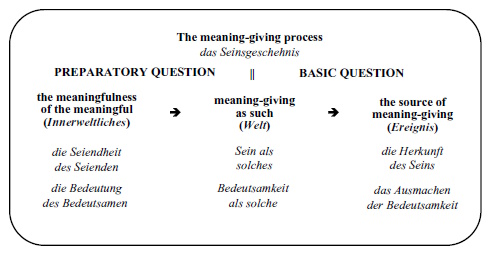
Heidegger’s thinking progresses, as we saw, through two questions, which we now may call the preparatory question and the basic question. Both of them concern the meaning-process, the spectrum running from meaningful things, to meaning-giving, to the source of meaning as such. However, the two questions approach that process from very different perspectives. The preparatory question seeks out what is responsible for the meaningfulness of things. The basic question, on the other hand, considers meaning in itself (a) without regard to its relation with the meaningful33 and (b) in order to search for the source of meaning at all. The table below, using the lexicon of meaning as well as Heidegger’s ontological vocabulary, offers a sketch of the two questions. (It is important to note that the meaning-process is a unified whole whose elements can be distinguished and individually discussed but cannot be separated from the whole.)
Reading the table from left to right: The preparatory question is “How and why are things meaningful?” and the answer is world in Heidegger’s sense of that term: the meaning-giving context that exists only in correlation with human being. On the other hand, the basic question is: “How is there meaning at all?” and the answer is: man’s thrown appropriation to the meaning-giving process. Heidegger spells out the preparatory issue as Anwesenlassen, letting things be meaningfully present, whereas he interprets the basic question as Anwesenlassen, appropriation’s allowing of Sein, Welt, and meaningfulness at all.34
Each human world or meaningful context discloses to understanding the meanings that can accrue to whatever is found within that world. The world is a set of possible relations that link tools to tasks, and subjects to predicates, thereby providing things with their significance. In the context of a downpour, for example, a piece of rough canvas has a different significance from what it might have if it showed up in an elegant living room. Human beings live in many distinct meaning-giving worlds at the same time. A mother, for instance, makes business calls from home in the evening while rocking her child to sleep and enjoying a Scotch. Each of those worlds – her job, her parenting, her desire to relax – has the function of providing a range of possible sense-making relations within its semantic field.35
The meaning-process begins with the obvious fact that, from one’s first encounter with things, they make sense. They are immediately imbued with meaningfulness – which is to say they are always already caught up in the ontological difference between meaning-giving and the meaningful. For example, that roundish rock over there, as soon as I encounter it within the context of a need of mine, appears to me as a mallet, or as a paper weight, or as a weapon – depending on the need and its context. Now we can thematically raise the preparatory question: How did this rock become (let us say) a mallet? And we will find the answer in the context or world that unfolds around my need to pound in some tent pegs in the absence of a hammer. That context renders meaningful this particular rock, while it excludes from the task that more frangible piece of slate. The early Heidegger discusses all this in Being and Time, Division I, Chapter 3, “The Worldhood of the World,” where he argues that the meaningfulness of a tool (its utility or serviceability) derives from the practical world of means-and-ends, and in this specific case, from the world of tool-use. That world establishes the relations (this-as-for-that: these tools for those tasks) that make this rock useful – i.e., practically meaningful – for pounding in tent pegs, and that other rock not. It is in this way that the world of practical activities is meaning-giving.
But the next question, the basic question, is: What is responsible for the world itself as meaning-giving, i.e., as an open region of understanding that allows for the meaning of this or that thing? This question asks not about the relation of the meaning-giving world to the meaningful but about the ever self-unifying togetherness of man and meaning whence unfolds the ontological difference between meaning-giving and the meaningful. In a word, it asks about appropriation.
We might pose the basic question in another frame of reference. Insofar as “world” in Heidegger’s sense is the sphere of “minding the meant” (i.e., making intentional sense of whatever we meet), “world” can be understood as “mind” in the very specific Heideggerian sense of the structural condition for making intentional sense of anything. Mind in this sense is a priori “open” and meaning-giving. When things come to mind, they are disclosed. In this form, “mind” is not unlike Aristotle’s ὁ νοῦς τῷ πάντα ποιεῖν [νοητά] (De anima, III 5, 430a 15), i.e., the aspect of mind that renders everything we encounter intelligible – or, in medieval parlance, the actuating intellect (intellectus agens [aliquid intelligibile]). Such νοῦς or mind is what Heidegger understands as human existence itself, as when he compares the lumen naturale or “natural light” of medieval epistemology to the Da, the “where-meaning-appears,” as the essence of human being (SZ 133.1 = Being and Time, 171.17). This lumen corresponds to the ϕῶς that Aristotle metaphorically describes as rendering things “luminous,” i.e., actually intelligible (De anima III, 5, 430a 16).
In this context, the preparatory question concerns how mind makes intentional sense of whatever it meets. On the other hand, the basic question asks: What is the source of mind? The early Heidegger would answer that question with In-der-Welt-sein, i.e., human thrownness into projectively sustaining (entwerfen) the openness that is mind as meaning-giving. Thanks to this thrown projectivity, we are always already familiar with meaning within a given world and thus can make sense of this or that innerworldly thing. Alternately, the later Heidegger answers that basic question with: the appropriation of man to “belonging” to mind and “holding it open” (zugehören, offenhalten). And since appropriation is man’s ineluctable/thrown relation to meaning, we may say that the source of mind is the fact that, in order to exist at all, man must belong to mind (zugehören), just as mind, if it is to exist at all, requires man (braucht). Ereignis is this hermeneutical circle of reciprocal need: human being’s need of Welt/mind as meaning-giving, and Welt/mind’s inability to subsist without human being. Ohne Da-sinn, kein Sinn. Ohne Sinn, kein Da-sinn.
But another objection: Doesn’t this interpretation ascribe too much power to human being? In brief, the answer is no. In 1951 and again in 1955 Heidegger insisted that within the hermeneutical bond of meaning and man, Sein and Dasein co-constitute each other.
As soon as I thoughtfully say “human nature,” I have already said relatedness to meaning. Likewise, as soon as I thoughtfully say: the meaning of the meaningful, I have already named its relatedness to human nature. Each of the two members of the relation between human nature and meaning already implies the relation itself … [T]he situation we have named between human nature and the meaning of the meaningful allows of no dialectical maneuvers in which one member of the relation is played off against the other.
And
We always say too little when, in speaking of meaning, we leave out its presence to human being and thereby fail to recognize that human being itself co-constitutes meaning. We also say too little of human being when in saying meaning (not human being) we posit human being for itself and only later bring it, as already posited, into a relation with meaning.36
Such being the case, the man-meaning relation – Ereignis – is one of coequal reciprocity. Yes, the later Heidegger emphasized the role of meaning (Sein) rather than that of man, but only so as to bend the twig back to the center and to emphasize what in fact had already been spelled out in Being and Time: that all projective holding open of the world is a thrown projection.37 Once one understands that, there is no problem with referring to the equal and reciprocal need of man for meaning and of meaning for man.
In Being and Time Heidegger treats man’s relation to meaning in Division I, Chapter 5, “Being-In.” He had already argued that the essential structure of any world (Bedeutsamkeit) is meaning-giving in correlation with man’s being “in” such a world. Being-in, far from having anything to do with ordinary space (within-ness), refers to our ever-operative but unthematic engagement with meaning-giving, without which we could not know anything as meaningful. Moreover, being-already-engaged-with-meaning (In-der-Welt-sein) is made up of man’s bivalent relation to meaning: on the one hand, passively having to be related to the meaning-giving process (otherwise there is no man) and on the other hand, actively holding open or sustaining the meaning-giving process (otherwise there is no meaning). In short, as already engaged, both passively and actively, with meaning-giving, man necessarily sustains mind as the locus of the meaning-process. Which is another way of articulating the function of Ereignis.
Nonetheless, and regardless of all the mental activities that go on within it, mind itself, along with its need to be sustained by man, remains ever in the background, undisclosed. How is that so? To understand mind we would have to presume and use mind to explain mind, which would be a petitio principii, begging the question. Unlike Aristotle’s god, human being is denied a complete transparency that would allow for such a direct intuition of itself. At best we can be reflexively aware of our awareness of things and can mind our minding of them. But mind itself in its basic whence, why, and whereunto can never be brought to full intelligibility. Everything is understandable except the reason why everything is understandable. If knowledge of something is had by knowing its “causes,” i.e., by giving an account of the reasons that explain it,38 we can never know the reason for our thrownness into and our sustaining of mind. We obviously can use mind – in fact are always using it – and we can even sense our own thrownness into mind. That is, we do have a relation to the intrinsic non-disclosure of mind, but that relation is between our ever-possible impossibility of minding things (Sein zum Tode) and mind’s impossibility of being disclosed, i.e., its intrinsic Verbergung.39 As the constituting source of meaning as such and of the meanings of things, the Ereignis relation remains ineluctably latent. It is impossible for us to master it. And the name of that impossibility is facticity.
A final thing that needs to be said about Ereignis concerns the much-discussed Kehre or “turn.” As commonly but incorrectly used by Heideggerians, “the turn” refers to the 1930s shift in the way Heidegger philosophized about his central topic. That shift was from the transcendental approach of Heidegger I to the so-called seinsgeschichtlich approach of Heidegger II. However, that shift (Wandel, Wende, Wendung) or reversal (Umkehr) is not the Kehre in its basic and proper sense. There is no doubt that Heidegger’s way of thinking about the disclosive source of meaning underwent a Wandel in the period 1930–1938, and that this change was first articulated publicly in his “Letter on Humanism” of 1947. But Heidegger took care to point out in Contributions to Philosophy (1936–1938) that the proper meaning of the “turn” is found not within this change of his thinking but only within Ereignis itself: die im Ereignis wesende Kehre.40
The clue to understanding the proper and basic sense of the Kehre lies in the German term with which Heidegger glosses Ereignis, namely, Gegenschwung: back-and-forth reciprocity. (The word “reciprocity” comes from the Latin reci-proci-tas, back-and-forth-ness.) The “turn” in its proper sense refers to the back-and-forth relation of need between man and meaning-giving: man needs meaning as much as meaning needs man. More specifically, the back-and-forth-ness refers to the two forms of the reciprocal need of man and meaning-giving: man’s passive submission to being appropriated to the meaning-process (Brauch) and man’s active sustaining of that process (Zugehören). The following table illustrates the reciprocal need of man for meaning and of meaning for man. It also illustrates (by way of the dots) the tension or Streit between passive thrownness/appropriation and active projection/sustaining of the meaning process.
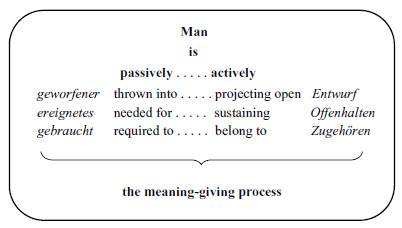
Thus the answer to Heidegger’s basic question “How does meaning occur at all?” is: It happens because man is “passively” thrown into (appropriated to, or needed for) “actively” sustaining the meaning-process. In a word: Ereignis as reciprocity.
Heidegger has a host of rich and potentially misleading metaphors to express this state of affairs, and he uses them liberally: Man is hailed, claimed, called out to, “thrown to,” evoked, or even pulled into Sein.41 Such language, of course, risks attributing quasi-personal agency to Sein. That, however, is a monstrosity that must be avoided at all costs. Therefore, Heideggerians should take the pledge and swear off the sauce of hypostasizing Sein. No more reifying of it into something that does the calling, claiming, throwing, or pulling. Rather, what these metaphors are trying to express is that, when it comes to man and meaning, you cannot have one without the other.
Facticity (Faktizität) is the early Heidegger’s term for man’s a priori thrownness into the ability to give meaning and thus for man’s ability to understand this or that thing. Facticity is an essential component of being-in-meaning (In-der-Welt-sein). It is a preliminary name for man’s appropriation to the factum of meaning-giving.
From the first pages of Being and Time Heidegger insisted that what makes human being unique is that it has to be (zu sein).42 “Human being exists as the thing that has to be how it is and how it can be.”43 Heidegger refers to this “having-to-be” as one’s being “delivered over to” and “burdened with” (überantwortet, belastet) the condition of being-in-meaning, which is the condition of “being-able-to-make-sense-of” (Seinkönnen). Human being lives into and out of its possibilities, which goes back to its one possibility: to make sense. We can feel this condition of facticity/ thrownness, but we can never understand its origins.
We are most immediately aware of our factical thrownness into sense-making through moods or feelings. These Heidegger anchors in the structural moment of human being that he calls Befindlichkeit, the condition of finding ourselves already affectively attuned to the meaning-giving process. Moods are the primary and basic way in which a world is disclosed to us, and Heidegger often describes this factical thrownness, this attunedness, as the naked Daß44 – the fact that we are always already engaged with the factum of meaning-giving, from which there is no escape.
But there is an extraordinary kind of mood, quite different from everyday moods and feelings, one in which we not only experience the world and its contents but above all confront the fact that there is no reason, no ground for why we are thrown together with meaning. This encounter with groundlessness is a matter of awestruck wonder, whether it take the form of sobering dread (Angst) or unshakeable joy (Freude).45 Heidegger calls these special moods Grundstimmungen, “foundational” moods that get to the foundationlessness of the meaning-process. The early Heidegger is better known for his analyses of the experience of dread than of joy, and we may gain some insight into how facticity and appropriation fit together – and in fact are the same phenomenon – by revisiting his treatment of dread in the 1929 lecture What is Metaphysics?46
In the second and third parts of the lecture, Heidegger portrays what such an experience of dread might feel like. Jean-Paul Sartre took up and transformed these pages in his early novel Nausea (1938), particularly in describing the protagonist Roquentin’s harrowing yet liberating experience of the absurd.47 And in fact whereas Heidegger employs the term “the nothing” (das Nichts) to name what we encounter in dread, we would do well to utilize the Sartrean term “absurd” (“lacking in any meaning at all”) as we employ the discourse of meaning to understand the core of Heidegger’s thinking. I will be using “absurd” not in a strict Sartrean sense of the term but in a Heideggerian-phenomenological sense based on the word’s etymology: that which is “deaf” (Latin, surdus) to any efforts to make sense of it: the abyss of meaninglessness (SZ 152.15).
Heidegger begins his analysis of the absurd with everyday, ordinary moods that disclose to our affective understanding not only the meaning of individual things in our lived experience but also the encompassing context that gives them meaning. He speaks, for example, of how the mood of boredom colors our feelings not just about a specific thing (say, this or that television show) but more broadly about the whole world of watching television. Similarly, although in a different emotional register, we can experience the mood of romantic love, which opens up an entirely new way of living à deux and transforms the significance of all that we encounter within that world. Heidegger’s analysis of these moods focuses on our attunement to the meaning-giving role of a world.
However, in contrast to such ordinary, everyday moods Heidegger invokes the fundamental mood of dread, which goes to the very basis of the world. Dread is not fear in the face of any specific thing that threatens us – say, that pit bull on the other side of the fence. Rather, it is overwhelming wonder in the face of the so-called “nothing,” the ultimate and inescapable absurdity that lurks beneath our everyday acts of making sense.
Imagine, he suggests, that, regardless of the reason, the meaning-giving world that you inhabit with such familiarity and comfort is, in an instant, thrown out of joint and completely collapses. In that terrifying moment everything is suddenly thrown into chaos and loses all meaning (no world = no meaning). Perhaps, like Sartre’s Roquentin, you cannot say what exactly happened between one step and another on some grey February day, but in that dramatic instant everything you once knew, everything you were once so sure of, gets detached from its predicates – practical, theoretical, or whatever – and begins to float free of its anchorage in the lived context that has abruptly disappeared. As they float away from their meanings, those things turn on you and press in upon you with a terrifying closeness. No longer mediated by the now-lost world, they become frighteningly immediate, with no semantic framework to situate them in a safe, meaningful relation to you. In fact, in this instant of terror you yourself float away from the calm and self-assured person that you were a second ago. In a flash of insight you realize that the world of meaning is based on nothing solid and has no ultimate raison d’être. The thin veil that previously separated you from your groundless facticity is torn asunder, and you have to face, for the first time, the absurdity of the burden you bear: having to make sense of things, with no founding or final reason. In confronting the ultimate meaninglessness of meaning-making, you realize that you once could make sense of everything, but now cannot make sense of sense-making itself. You encounter the absurd – not just this or that puzzle or problem to be solved, but the very real fact that making sense is ultimately an ungrounded and futile task into which you are thrown by the sheer fact of being human. As Heidegger puts it, for that brief instant you “hang suspended” over the abyss of the absurd.
But, as ultimately senseless as making-sense is, you also see, in a flash of insight, that sense-making is the only thing that separates you from your death, which, of course, will be the end of all meaning for you. Sense-making may be finite, limited, groundless, and with no final outcome, but at least it’s not death and nothingness. This encounter with absolute absurdity – the nothing – is an encounter with the possibility of your own impossibility and thus with the awareness that mortal sense-making is all that stands between you and your death. But surprisingly such an encounter with the absurd does not suck you into your death – it neither kills you nor encourages suicide – but rather throws you back upon your mortal self as groundless engagement-with-meaning. You cannot make sense of the absurd – trying to do so would itself be absurd – but you can make sense of everything else as you stand there with your back pressed up against your death. You see that, despite its groundlessness, your mortal understanding of meaning is the thin line holding back your nothingness, and that, even in your daily life of sense-making, you are at each moment already at the point of death – and at the point of life.
If fundamental moods like dread confront you with the groundlessness of being-in-meaning, they also offer you the possibility of fleeing from this experience of nothing-to-hold-on-to. You can retreat from this awareness of facticity and try to continue your life in the everyday ways that paper over your mortality and the final absurdity of living – like the protagonist of T. S. Eliot’s “The Love Song of J. Alfred Prufrock,” who, once having seen “the thing itself,” flees it.
Though I have seen my head (grown slightly bald) brought in upon a platter,
I am no prophet – and here’s no great matter;
I have seen the moment of my greatness flicker,
And I have seen the eternal Footman hold my coat, and snicker,
And in short, I was afraid.
And would it have been worth it, after all
…
To have squeezed the universe into a ball
To roll it towards some overwhelming question,
To say: “I am Lazarus, come back from the dead,
Come back to tell you all, … ?”
…
No! I am not Prince Hamlet, nor was meant to be; …
Prufrock has a riveting vision of his factical, absurd mortality – the eternal Footman – but then takes flight into a world of erotic fantasy, even though that life will prove to be only a suffocating death-in-life:
We have lingered in the chambers of the sea
By sea-girls wreathed with seaweed red and brown
Till human voices wake us, and we drown.48
(Notice how subtly the poem begins with Prufrock, in the form of Guido da Montefeltro, speaking to you, the reader, from a safe distance – “senza tema d’ infamia ti rispondo.” The poem then progresses to your own side-by-side journey with him – “Let us go then, you and I” – and concludes with your virtual identification with Prufrock: “We have lingered … Till human voice wake us, and we drown.”)
The alternative to Prufrock’s flight would be to let yourself be held-outinto nothingness for a cold, focused moment – to hang suspended, with nothing to hold on to, over the abyss of the utter absurdity that gapes at the heart of your factical life. It would be to feel what is at stake in the seemingly innocent act of making sense of things. You could finally, despite the ultimate futility of it all, wake up to that absurdity, live through it and in an act of resolve accept it as the human condition, and then take responsibility, without appeal, for the sense you make.
A person may be “sure,” because of his faith, of where he is going; or may think that, thanks to rational enlightenment, he knows where he came from. But all that counts for nothing against the experience of dread, which confronts you with the sheer fact that you are thrown into making sense, a fact that now stares you in the face as an unfathomable enigma. (Cf. SZ 136.1–5 = Being and Time, 175.4–9)
In either case, whether you flee this awareness like Prufrock or live into the experience with trembling courage and faint hope, the outcome is the same. Experiencing the possibility of no-meaning-at-all – the possibility of your own impossibility – throws you back upon yourself as mortal engagement-with-meaning, but now with a choice: either to forget your experience of your own groundlessness, or to hold on to that awareness and make it your own (eigentlich) as you return to the everyday business of living. This push-back from death – which is what mortality is and what the absurd does – will be the same for both the feckless Prufrock and the person of resolve as they face their facticity. What distinguishes them is their decision about living with that awareness. As Heidegger puts it: “The question of existence is clarified only by how you exist” (SZ 12.30–31 = Being and Time, 33.8–9).
In What is Metaphysics? Heidegger employs a puzzling phrase that describes this throw-back from the absurd. He writes: das Nichts nichtet (“The nothing nothings”). The phrase seems to defy translation. However, in the sentences that precede the phrase (as well as in his marginal notes to the lecture), Heidegger tells us precisely what he means.
In dread you “draw back” from the absurd. This is not flight. It is the calmness of wonder. This movement “back from” is initiated by the absurd that you are experiencing. The absurd does not draw you into itself; rather, of its own nature it pushes you back. In pushing you back from itself, it directs you to the very things that you experience as slipping out of meaning. This business of pushing you back from itself and directing you toward the things that are slipping out of meaning is how the absurd presses in upon you during dread. This is die Nichtung, that is, the essence of the absurd and the way it acts. The absurd does not annihilate things, nor does it result from acts of negation. Annihilation and negation cannot account for the essence of the absurd. Das Nichts nichtet. The absurd pushes you back from itself.49
In ontological language: this “nothing” directs you back to beings in their being. In phenomenological discourse, experiencing the groundlessness of sense-making returns you to the meaningful in its meaningfulness, with an awareness that mortality – being ever at the point of death – underlies the entire meaning-process. Whatever you decide to do with this experience – to remain oblivious of it (like Prufrock’s beloved), or to flee it (like Prufrock himself), or to embrace it in an act of resolve – in each case, the absurd will always be, as Heidegger says, “slumbering” within your experience, with the possibility of awaking at any moment.50
Facticity as human thrownness-into/appropriation-into the factum of the groundless meaning-giving process functions centrally within Heidegger’s earlier and later work. In Being and Time, for example, it is one of the three moments that make up the structure of care and hermeneutical openness (“temporality”).
Care, which is the always self-unifying engagement with meaning, is composed of three moments, Faktizität, Existentialität, and Sein-bei, that finally reduce to two: (a) factical existentiality as living into possibilities of meaning and (b) rendering things meaningfully present. As a whole, these three-moments-reduced-to-two constitute the meaning of man, which Being and Time calls, as a whole, Rede or λόγος: sense-making. (The widespread but false notion that Rede/λόγος is the third component of care – rather than naming the whole of being-in-the-world – can be traced back to Alphonse de Waehlens’ misreading in La Philosophie de Martin Heidegger, 1942.)51
Heidegger uses “existentiality” as a name for the human condition of being “ahead of oneself,” living in the necessity and ability to “become” oneself (Zukünftigkeit). “Existentiality” refers to the essential condition of living into the potentially endless but de facto finite – hence, the finitely infinite – ability in principle to make endless sense of everything, including oneself. “Facticity,” on the other hand, bespeaks our structural condition of thrownness into that ability. If we think of “factical” as an adjective modifying “existentiality,” and then bring these two together, we may say that man is a priori thrown ahead of its everyday self into its necessary ability to sustain the meaning-process. In short, these two moments of facticity and existentiality come down to one: thrown-aheadness into meaning-giving. If, as Heidegger declares, “Possibility is higher than actuality” (SZ 38.29–30 = Being and Time, 63.2), so too the thrown ability to be engaged with sense as such is what allows for the actuality of making sense of particular things, in a kind of “return” from our aheadness in our a priori ability-to-make-sense to actual sense-making (see the following table).
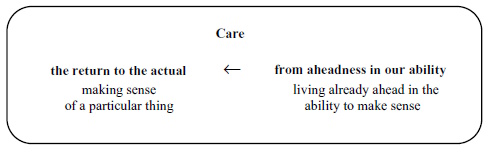
In this configuration we can already see what Heidegger will argue is the basis of care and therefore of being-in-the-world – namely, authentic “temporality”:
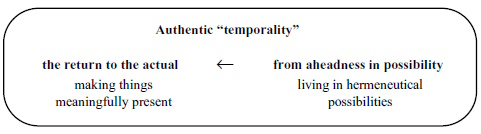
The same three moments, collapsed into two, hold as well in the case of existential “temporality”: already-aheadness (facticity and existentiality) and making-things-meaningfully-present (gegenwärtigen). “Temporality” is about human becoming in the realm of sense, not in the field of ordinary time as past–present–future. Heidegger defines “temporality” as our condition of being the movement of having to become what we already are – where “what we are” is the finite ability to make endless sense of whatever we meet. Temporality is about human beings becoming themselves as sense-makers as they make sense of this or that. But “becoming” is what we already are; and so the specific form of that becoming is: ever-coming-to-ourselves as the necessity and ability to make sense. Thus the so-called “futurity” of existential human being is in fact the content of its structural condition of facticity, i.e., being “thrown ahead” into the ability to make sense of everything; and from that aheadness we have always already “returned” to the actual, concrete realm of making sense of specific things. Care and temporality fold into each other as different forms of the movement of ἑρμενεία.52
This essay has argued that stepping out of the misleading discourse of “being” and taking one’s stand in the phenomenological reduction of “being” to “meaning” not only is possible and necessary in itself but also clarifies the structure and function of appropriation and facticity. Both Ereignis and Faktizität bespeak the same thing: the “fate” of human being as necessary for maintaining (holding open) the meaning-giving process. Given that the term “being” has a long-standing and solid claim to meaning “existing out there,” phenomenology needs to subject it to the phenomenological reduction that alone, Heidegger claimed, gives entry to his thought and, for him, sustained that thinking throughout his career.
If it is the case – as Heidegger stated in Being and Time and maintained to the end – that being occurs only in the understanding of human being; if being and its disclosure to understanding are simultaneous and in fact the same; and if “being that can be understood is meaning,” then it holds that being is always “ad hominem,” it enters phenomenological-hermeneutical discourse only κατὰ τὸν λόγον (Physics II 1, 193b2–3), in relation to man’s sense-making abilities. Anything outside of this λόγος/ἀλήθεια is unknown until it enters the realm of sense. For we have knowledge of things only through their meaning, and meaning at all levels is a matter of disclosure-to-understanding: ἀλήθεια.
1 On “time” as a preliminary name (Vorname) for disclosure, see GA 9: 377.4 = Pathm 286.13; and GA 14: 36.11–12 = TB 28.20–21. I cite texts by page and line, separated by a period. The line-count does not include headers but does count titles within the text. Unless otherwise noted, all translations and paraphrases are my own, but I do refer to the corresponding pages and lines in existing translations.
2 Heidegger often follows this usage (Mensch as Dasein), for example, at GA 14: 28.8, 15, and 19 = TB 23.6–7, 12, and 19. For Heidegger’s claim that “Dasein” should not be translated, see GA 65: 300.13 = Cph 211.41: “In der Bedeutung, die ‘Sein und Zeit’ erstmals und eigentlich ansetzt, ist dies Wort [Da-sein] nicht zu übersetzen …” Cf. GA 65: 299.18 = Cph 211.19–20: “selbst nirgendwo unterbringbar.” On formal indication, see Daniel Dahlstrom, Heidegger’s Concept of Truth (Cambridge University Press, 2001), 242–252.
3 Analogous to the medieval thesis that having being entails giving being: Thomas Aquinas, Summa Contra Gentes, II, 6, no. 4.
4 GA 9: 316, n. “a”
= Pathm 241,
n. “b”: “Denn ‘Ereignis’ seit 1936 das Leitwort meines Denkens.”
Cf. also GA 12: 248, n. 2
= On the Way to Language, 129
n. On the sameness of Wahrheit, Wesen,
ἀλήθεια,
Sein, Sein, Lichtung, Da, Unverborgenheit, Offenheit, Welt, Unterschied, Entwurfbereich,
Sinn, Ereignis,
and Kehre, see GA 14: 36.17–18
= TB 28.24–25.
Zollikoner Seminare 242.12–13
= ZSe 194.33–35.
Also GA 65: 318.21–23
= CPh 223.38–40;
also ibid. 331.23
= 232.27–28; and § 130 in both
texts. Also GA 9: 336.27
= Pathm 256.23–24;
and ibid. 369, n. d
= 280, n. d;
and ibid. 201.22–24 and 30–32
= 154.5–7 and 12–14;
and ibid. 325.20–21
= 248.11–12;
and ibid. 336.27
= 256.23–24.
5 In phenomenology “there are no other philosophical problems except problems of sense, meaning, and signification,” Aron Gurwitsch, review of Gaston Berger, “Le cogito dans la philosophie de Husserl,” Philosophy and Phenomenological Research, 7/4 (1947): 649–654, here 652.
6 Hans-Georg Gadamer, Truth and Method, trans. Joel Weinsheimer and Donald G. Marshall (London and New York: Continuum, 1989), 470.3–4: “Being that can be understood is language.” Italicized in the original.
7 According to the context, I use “sense-making” either (a) as an a priori term, i.e., as the condition of the possibility of understanding this or that thing, or (b) as an a posteriori term, i.e., as an actual instance of understanding (making intentional sense of) some thing or state of affairs. Man’s relation to sense-making in the second sense would correspond to (a non-Husserlian) intentionality, whereas man’s relation to the first would be Heideggerian transcendence. Cf. GA 24: 91.20–22 = BPP 65.15–16: “Intentionality is the ratio cognoscendi of transcendence. Transcendence is the ratio essendi of intentionality in its various modes.”
8 Cf. GA 9: 307.23–24 = Pathm 234.18: “daß Seiendes ist.” Also see GA 52: 64.24–25: “[der] Wunder nämlich daß überhaupt eine Welt um uns weltet, daß Seiendes ist und nicht vielmehr nichts” – that is: the wonder that a world sheds meaning around us, that things are meaningful and not meaningless.
9 See “Phenomenology” (Encyclopaedia Britannica Article), Draft A, in Edmund Husserl, Psychological and Transcendental Phenomenology and the Confrontation with Heidegger (1927–1931), ed. and trans. Thomas Sheehan and Richard E. Palmer (Dordrecht, Boston, and London: Kluwer, 1997), 91.12–14 (the emphasis on “of this house” is my own). The phenomenologist, however, must refrain from working with the thing apart from the human sense-making relation to the thing; ibid. 91.27–29; see also, ibid. 83–84 and 90–92.
10 SZ 230.6–7 = Being and Time, 272.35–36: “Sein und Wahrheit ‘sind’ gleichursprünglich.” Cf. below.
11 On this, see Heidegger’s letter to Husserl, October 22, 1927, GA 14: 131.3–17 = Husserl, Psychological and Transcendental Phenomenology, 138.3–14: “What is the mode of being of the entity in which ‘world’ is constituted? That is the central problem of Being and Time. … Human being harbors within itself the possibility of transcendental constitution. … Transcendental constitution is a central possibility of the existence of the factical self.”
12 I borrow the phrase “already-out-there-now-real” from Bernard Lonergan, Insight (London and New York: Longmans, Green, 1957), 251.21. See also Aristotle’s ἔξω [τὴς διανοίας] (“outside of thinking”) at Metaphysics, VI 4, 1028a 2, and ἔξω ὂν καὶ χωριστόν (“a thing that is outside and separate from [thinking]”); ibid. XI 8, 1065a 24.
13 For the equivalence of “understand” and “project” see SZ 306.7–8 = Being and Time, 353.41 f.: “entwirft … das heißt versteht.” Also GA 15: 335.1–2 = FS 40.41–42: “‘Sinn’ ist vom ‘Entwurf’ hir zu verstehen, der sich durch ‘Verstehhttps://www.beyng.com/gaselis/?vol=3&pg=235en’ erklärt.” Also GA 14: 39.32 = TB 31.31–32: “[Wenn] das Entwurf in und als Verstehen geschieht.” Also GA 3: 235.19–20 = Kant and the Problem of Metaphysics, 165.12: “Dieses Entwerfen (Verstehen).”
14 GA 9: 30.10, 17–19, 21–26 = Pathm 26.8, 14–17, 23–25. The word “bekümmerten” (concernful) is emphasized in the original.
15 On “making a difference,” see Richard Polt, “Ereignis,” in A Companion to Heidegger, ed. Hubert L. Dreyfus and Mark A. Wrathall (Oxford: Blackwell, 2005), 375–391, here 383.21–22.
16 GA 21: 151.4–5 = Logic: The Question of Truth, 127.30–32: “Weil Dasein in seinem Sein selbst bedeutend ist, lebt es in Bedeutungen und kann sich als diese aussprechen.” My emphasis within the translation.
17 SZ 212.4–5 = Being and Time, 255.10–11: “Allerdings nur solange Dasein ist, das heißt die ontische Möglichkeit von Seinsverständnis, ‘gibt es’ Sein.”
18 GA 2: 244.5 = SZ 183.29–30 = Being and Time, 228.12–13. “Sein aber ‘ist’ nur im Verstehen des Seienden, zu dessen Sein so etwas wie Seinsverständnis gehört.”
19 SZ 230.5–6 = Being and Time, 272.34–35: “Sein – nicht Seiendes – ‘gibt es’ nur, sofern Wahrheit ist. Und sie ist nur, sofern und solange Dasein ist. Sein und Wahrheit ‘sind’ gleichursprünglich.”
20 See Heidegger, “The Understanding of Time in Phenomenology and in the Thinking of the Being-Question,” trans. Thomas Sheehan and Frederick Elliston, Southwestern Journal of Philosophy, 10/2 (1979): 200–201, here 201.1. Also William J. Richardson, Heidegger: Through Phenomenology to Thought (1963), pp. xvi, 1–7; also 44.1–2 with n. 47; also 537.26–28: “It is singularly important to realize that Heidegger never abandons the phenomenological attitude that seeks only to let the phenomenon manifest itself.”
21 GA 14: 50.3 = TB 41.5: “das Sein … nicht mehr das eigens zu Denkende ist.” See also below.
22 GA 56/57: 73.1–5 = TDP 61.24–28: “das Bedeutsame ist das Primäre, gibt sich mir unmittelbar, ohne jeden gedanklichen Umweg über ein Sacherfassen. In einer Umwelt lebend, bedeutet es mir überall und immer, es ist alles welthaft, ‘es weltet’.” The phrase “Die Welt weltet” (= “The world enworlds things”) means that the world allows for the meaning of whatever is found within the world.
23 See Heidegger’s important retractio on “truth” at GA 14: 86.16–21 and n. = TB 70.2–5 and n. 5.
24 Here I follow John Sallis’s translation: GA 9: 199.21 = Pathm 152.24.
25 GA 14: 90.3–4 = TB 73.3. “Woher aber und wie gibt es die Lichtung?” and ibid. 46.5 = 37.14–15: “von woher und wie es ‘das Offene’ gibt?” Also “Wie west das Seyn?”: GA 65: 72.22 = CPh 54.35. On the equivalence of “world” and “the realm of clarity,” cf. GA 9: 326.15–16 = Pathm 248.36–37: “die Lichtung des Seins, und nur sie, ist ‘Welt’.”
26 Heidegger associates the ontological difference with ontology and metaphysics; GA 65: 424.15–16 = CPh 299.13–14: the ontological difference is “[die] Ontologie tragenden Unterscheidung.” His interest is to trace that difference back to its self-unifying “identity” in Ereignis.
27 Cf. GA 15: 366.31–32 = FS 61.4: “Mit dem Ereignis wird überhaupt nicht mehr griechisch gedacht.
28 GA 14: 49.28–50.7 = TB 40.34–41.8. Further on the embeddedness of being in Ereignis, see ibid. 25.20–21 = 20.17.
29 I use “to constitute” in the sense of “ausmachen” in GA 9: 244.25–28 = Pathm 187.22–24 and of “mitausmacht,” ibid. 407.25 = 308.6. See also Heidegger’s use of Konstitution and konstituieren, “Phenomenology,” in Husserl, Psychological and Transcendental Phenomenology, 138.1–17.
30 GA 14: 27.8 = TB 22.3–4: “Sein verschwindet im Ereignis.” Cf. GA 9: 366, n. “a” = Pathm 278, n. “a”: “Sein verschwindet in die Wahrheit.”
31 GA 65: 304.8 = CPh 214.22. Further examples include ibid. 34.9 = 24.32: “die Er-eignung, das Geworfenwerden”; and ibid. 239.5 = 169.12: “geworfener … d.h. er-eignet.” Cf. also, SZ 325.37 = Being and Time, 373.14–15 (“Übernahme der Geworfenheit”) with GA 65: 322.7–8 = CPh 226.13–14 (“Über-nahme der Er-eignung”); and ibid. 320.16–17 = 225.5–6: “Übernahme der Zugehörigkeit in die Wahrheit des Seins.”
32 GA 16: 704.1–5: “Und der Grundgedanke meines Denkens ist gerade der, daß das Sein beziehungsweise die Offenbarkeit des Seins den Menschen braucht und daß der Mensch nur Mensch ist, sofern er in der Offenbarkeit des Seins steht.”
33 GA 14: 29.29–30 = TB 24.17–18: “Ohne Rücksicht auf die Beziehung des Seins zum Seienden.”
34 GA 14: 45.28–30 = TB 37.4–6. The text is misprinted in the English translation.
35 Cf. Thomas Sheehan, “Dasein” in A Companion to Heidegger, ed. Hubert L. Dreyfus and Mark A. Wrathall (Oxford: Blackwell, 2005), 199.19–27.
36 GA 8: 85.13–19 = What Calls for Thinking, 79.19–22 and GA 9: 407.22–8 (cf. 412.1–3) = Pathm 308.3–9 (cf. 311.21–3); Thus, whenever I use the terms “man” or “human being,” I always intend them as completed by the word meaning – as in “man-meaning.”
37 Cf. GA 65: 239.4–5 = CPh 169.11–12: “daß der Werfer des Entwurfs als geworfener sich erfährt.”
38 Metaphysics, I 3, 983a 25–26: τὴν πρώτην αἰτίαν γνωρίζειν. Also Virgil, Georgics, II, 490: “felix, qui potuit rerum cognoscere causas.”
39 See GA 65: 324.16–21, 28–32 = CPh 227.39–228.1–2 and 9–13: At the very edge of our openness, we are bound up with hiddenness – our utmost not-there-ness – which we know in the form of death as our utmost possibility. Death is the complete other of our openness. It is hidden from us, but, as hidden, it belongs essentially to our thrown-open-ness and needs to be sustained as the basis of our standing within meaning.
40 GA 9: 193, n. “a” = Pathm 148, n. “a.” Cf. “the Kehre in Ereignis GA 65: 34.10–11 = CPh 24.33 (and passim: cf. GA 65: 57.10; 262.3–4; 267.12; 320.19; 325.9–10; 407.6). See also Thomas Sheehan, “The Turn” in Martin Heidegger: Key Concepts, ed. Bret W. Davis (Durham: Acumen, 2010), 82–101.
41 The verbs are, respectively, grüßen, ansprechen, heißen, zurufen, zuwerfen, and ziehen.
42 In GA 2 (Sein und Zeit): 56, n. “d,” Heidegger glosses the phrase Zu-sein with “daß es zu seyn hat,” i.e., “that it has to be.”
43 SZ 276.17–18 = Being and Time, 321.11–12: “Es existiert als Seiendes, das, wie es ist und sein kann, zu sein hat.”
44 See SZ 134.37 = Being and Time, 173.28: “das Sein des Daseins als nacktes ‘Daß es ist und zu sein hat’.”
45 SZ 310.14–15 = Being and Time, 358.6–7: “die nüchterne Angst, die gerüstete Freude” – the latter due to the sense of freedom that follows upon the act of resolve.
46 GA 9: 103–122 = Pathm 82–96. See also “Reading ‘What is Metaphysics?’,” trans. Thomas Sheehan, The New Yearbook for Phenomenology and Phenomenological Philosophy, I (2001), 181–199.
47 Jean-Paul Sartre, La nausée (Paris: Gallimard, 1938) = Nausea, trans. Lloyd Alexander (New York: New Directions, 1964).
48 The Complete Poems and Plays of T. S. Eliot, ed. Valerie Eliot (London: Faber and Faber, 1969), 16–17.
49 Cf. GA 9: 114.1–16 = Pathm 90.15–24. The last sentence of the lecture should read: “Why are there meaningful things at all instead of the absurd?”
50 GA 9: 117.32, 118.12–13 = Pathm 93.11, 21.
51 See the author’s “Heidegger’s New Aspect: On In-Sein, Zeitlichkeit, and The Genesis of ‘Being and Time’,” Research in Phenomenology, 25 (1995): 207–225, esp. 211–212. Note that Rede has no specific corresponding ecstasis (SZ 349.7–8 = Being and Time, 400.18–19). If anything, Rede corresponds to the “fourth dimension of time”: Nähern der Nähe/Nahheit (GA 14: 20.12 = TB 15.30).
52 (1) In one sense, rendering-something-meaningfully-present is “released” from the “futurity” of ever becoming: SZ 326.20–21 = Being and Time, 374.11–12. (2) However, Heidegger correctly notes that one’s a priori engagement-with-sense (one’s “alreadiness” or Gewesenheit) gives rise to both aheadness-in-sense-making and making-things-meaningfully-present: SZ 344.14–16 = Being and Time, 394.27–29. (3) He also asserts that making-meaningfully-present has a privileged function in temporality: SZ 349.10–11 = Being and Time, 400.22–23.
Thomas Sheehan - Facticity and Ereignis
Original PDF.